
Comparison
AccuRanker vs Semrush vs Crawler Que (2026): Rank Tracking, Audits & AI Visibility
AccuRanker, Semrush, and Crawler Que answer three different questions. AccuRanker tells you where you rank, with the most precise daily tracking in the industry. Semrush tells you everything about the search market if you have an analyst to dig through it. Crawler Que tells you what to fix and how visible you are across Google and AI assistants in one client-ready report.
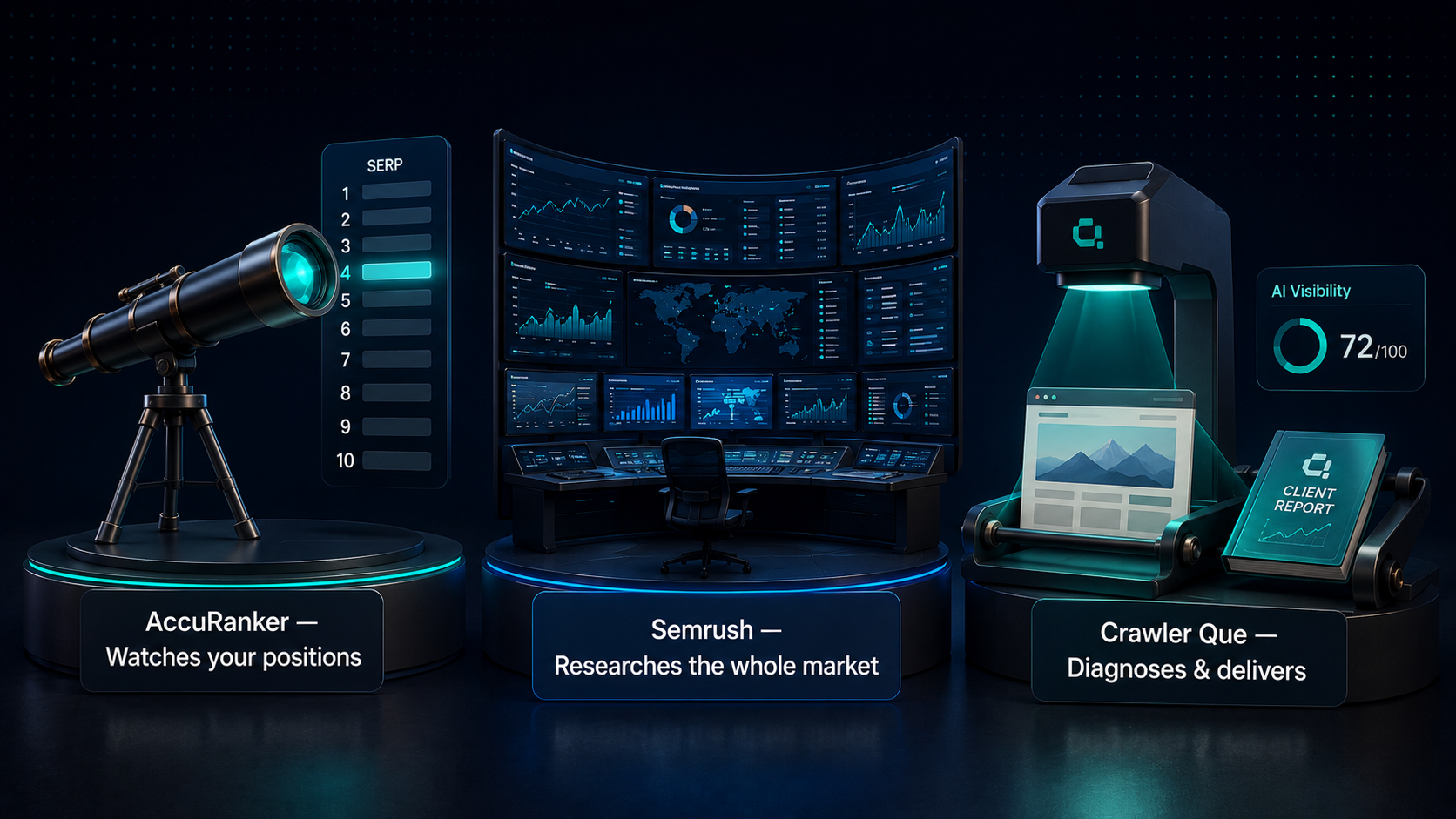
Most comparison posts pretend these tools compete head-on. They don't. The real question is which question your business actually needs answered and what you're overpaying to answer the wrong one.
Choose AccuRanker for large-scale daily rank tracking precision. Choose Semrush for deep research with a dedicated analyst. Choose Crawler Que for full audits, AI visibility, and white-label reports from $30/month.
See what's in every plan →
The 30-Second Verdict
| Your situation | Best fit |
| Tracking 2,000+ keywords daily across many client domains | AccuRanker |
| Full-time analyst doing keyword, backlink, and market research | Semrush |
| Agency or team producing audits and client reports | Crawler Que |
| You need AI visibility (ChatGPT, Gemini, Perplexity) without enterprise pricing | Crawler Que |
What Is Each Tool Actually Built For?
AccuRanker is a rank tracking specialist
Daily updates standard; on-demand refresh, unlimited users and domains on every plan, and a Share of Voice module that turns positions into market-share language clients understand. Independent reviewers consistently rate it the most accurate rank tracker available. What it doesn't do: site audits, backlink analysis, or meaningful keyword research. Reviewers themselves describe those as thin. It measures one thing, brilliantly.
Semrush is the everything suite
The deepest keyword and backlink databases in the industry, rank tracking included, though its Pro tier caps tracking at 500 keywords, a fraction of AccuRanker's floor. AI visibility exists as a separate $99/month add-on, or inside Semrush One bundles from $199/month.
Crawler Que is a deliverable engine
One URL becomes a complete audit: SEO intelligence, traffic modelling with confidence labels, Core Web Vitals, competitor intel, backlink authority, and an AI Search Visibility score from 0–100, exported as an 18-page white-label PDF. It doesn't try to out-track AccuRanker or out-research Semrush. It turns diagnosis into a document you can hand to a client.
Pricing: Three Very Different Bills
| Cost factor (2026, monthly billing) | AccuRanker | Semrush | Crawler Que |
| Entry plan | From ~$116/mo (1K keywords); ~$224/mo for 2K | $165.17/mo (Pro) | $30/mo (Starter) |
| Mid plan | ~$485/mo (5K keywords) | $248.17/mo (Guru) | $99/mo (Agency) |
| Extra user seats | Unlimited users included | +$45/mo (starting price) | 3 seats included on Agency |
| Rank tracking | Daily, best-in-class | 500 keywords on Pro | Position data per audit |
| Site audit modules | No | Yes | All 8 modules |
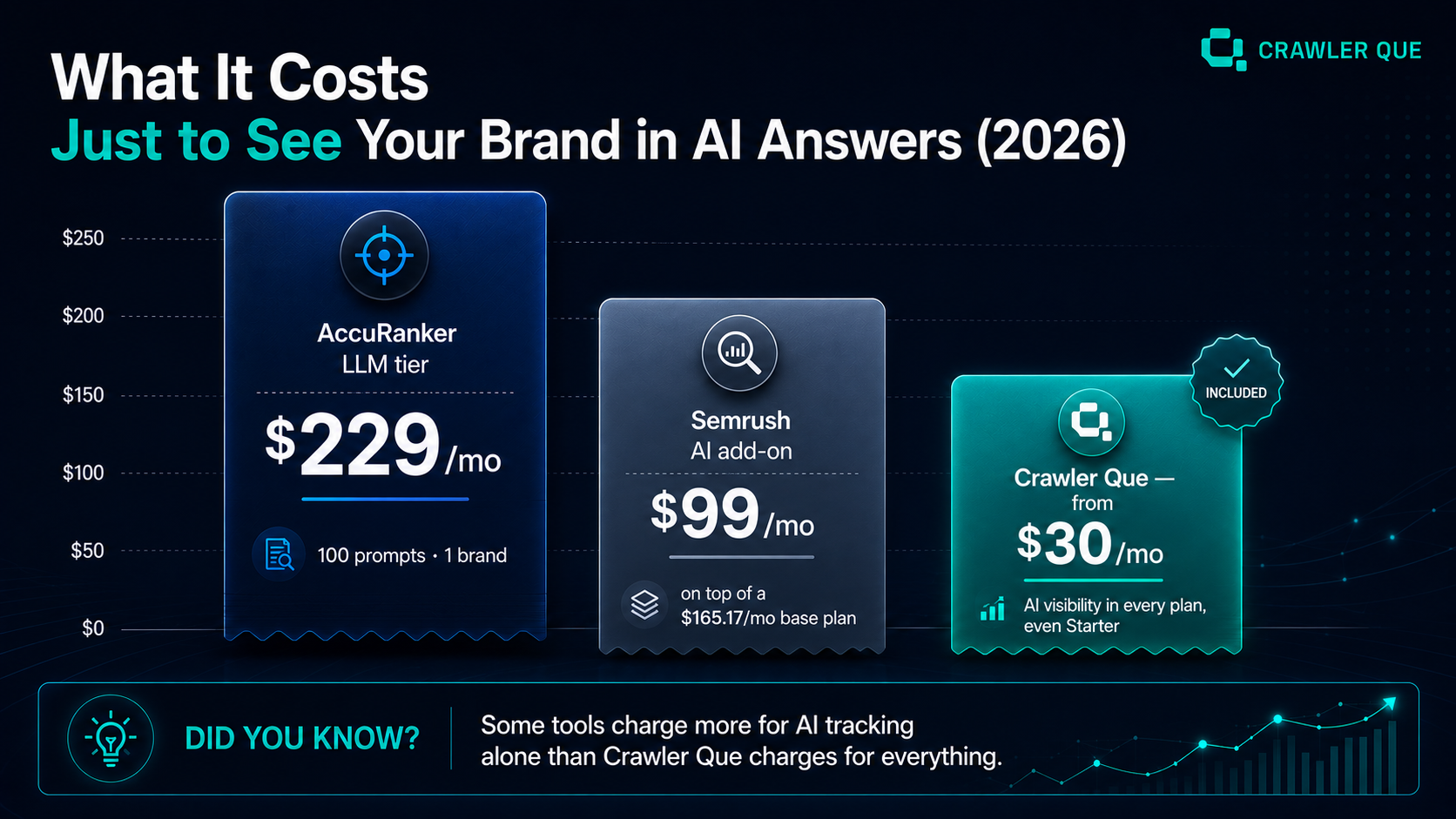
| AI / LLM visibility | Separate LLM tier listed at $229/mo (100 prompts, 1 brand) | +$99/mo add-on (or Semrush One from $199/mo) | Included on every plan |
| White-label reporting | Standard | Higher tiers/add-ons | Included from $99/mo |
| Free option | 14-day trial | Limited free tier | Full free audit, no signup |
Prices and features may vary.
Now the math agencies actually face. Running the popular two-tool stack — AccuRanker for tracking (~$224/month at 2,000 keywords) plus Semrush Pro for research ($165.17/month), costs about $389/month, roughly $4,670/year. Add Semrush's AI visibility toolkit, and you're near $488/month, about $5,858/year.
And here's the line item that stops people: AccuRanker's LLM tracking tier alone is listed at $229/month for 100 prompts and a single brand. Crawler Que includes AI visibility scoring on its $30/month Starter plan, and its full Agency plan is $99/month with 40 audits, 3 seats, and white-label PDFs.
Do I Need AccuRanker AND Semrush?
This stack exists because each tool has a hole the other fills: Semrush's rank tracking is shallow at lower tiers; AccuRanker can't audit or research. But before paying for both, ask what the outputs are for.
If the answer is client reporting like proving progress, flagging issues, recommending next steps, the stack is overkill. An audit platform produces that deliverable directly: scores, prioritized fixes, competitor benchmarks, and a 30/60/90-day roadmap in one PDF. Look at the Recommendations section of the sample report, and you'll see the format most clients actually want: not dashboards, decisions.
If the answer is daily operational tracking of 10,000 keywords plus deep market research, then yes, the specialist stack earns its cost, and Crawler Que becomes the reporting layer on top rather than a replacement.
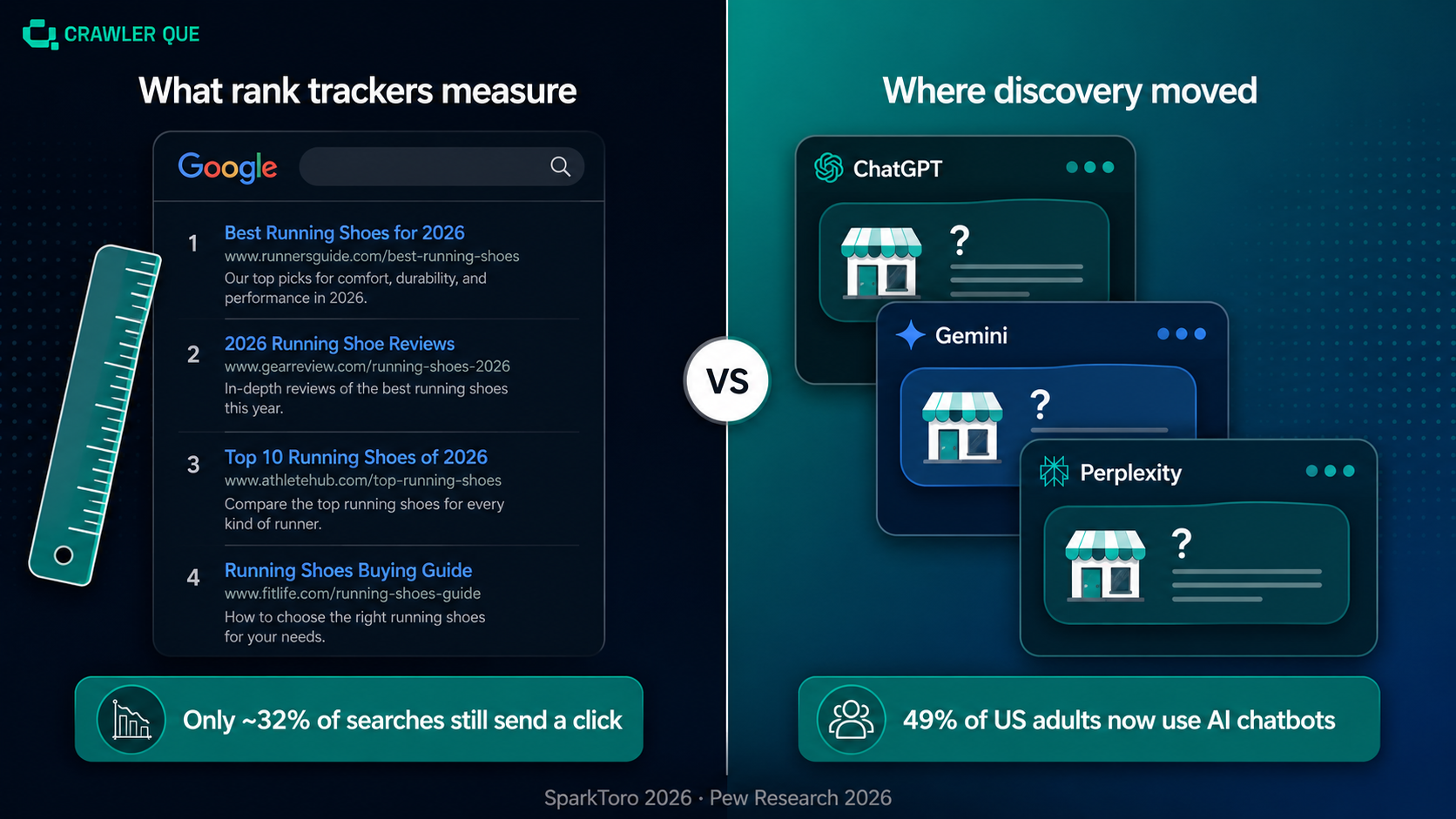
There's a bigger-picture reason to rethink rank-only spending, though. SparkToro's 2026 research found 68% of US Google searches now end without a click, and Pew reports 49% of US adults use AI chatbots, with information search as the top use. Every dollar spent tracking blue-link positions measures a shrinking slice of discovery. The growing slice of AI answers is exactly what legacy rank trackers weren't built to see.
Frequently Asked Questions
What is the most accurate SEO tool?
Is AccuRanker better than Semrush?
Is SEO dead or evolving in 2026?
Is Ubersuggest better than Semrush?
Which AI is best for SEO optimization?
Want to audit your website?
Run a Crawler Que audit to check SEO, Core Web Vitals, traffic signals, competitors, backlinks, recommendations, and AI search visibility.
Run website audit