
Comparison
RankIQ vs Semrush vs Crawler Que: Which SEO Tool Actually Fits a Lean Content Team in 2026?
RankIQ, Semrush, and Crawler Que solve three different problems. RankIQ optimizes individual blog posts. Semrush gives analysts an enterprise research suite. Crawler Que turns any URL into a client-ready audit, including AI search visibility, which the other two either lack or sell as an expensive add-on.
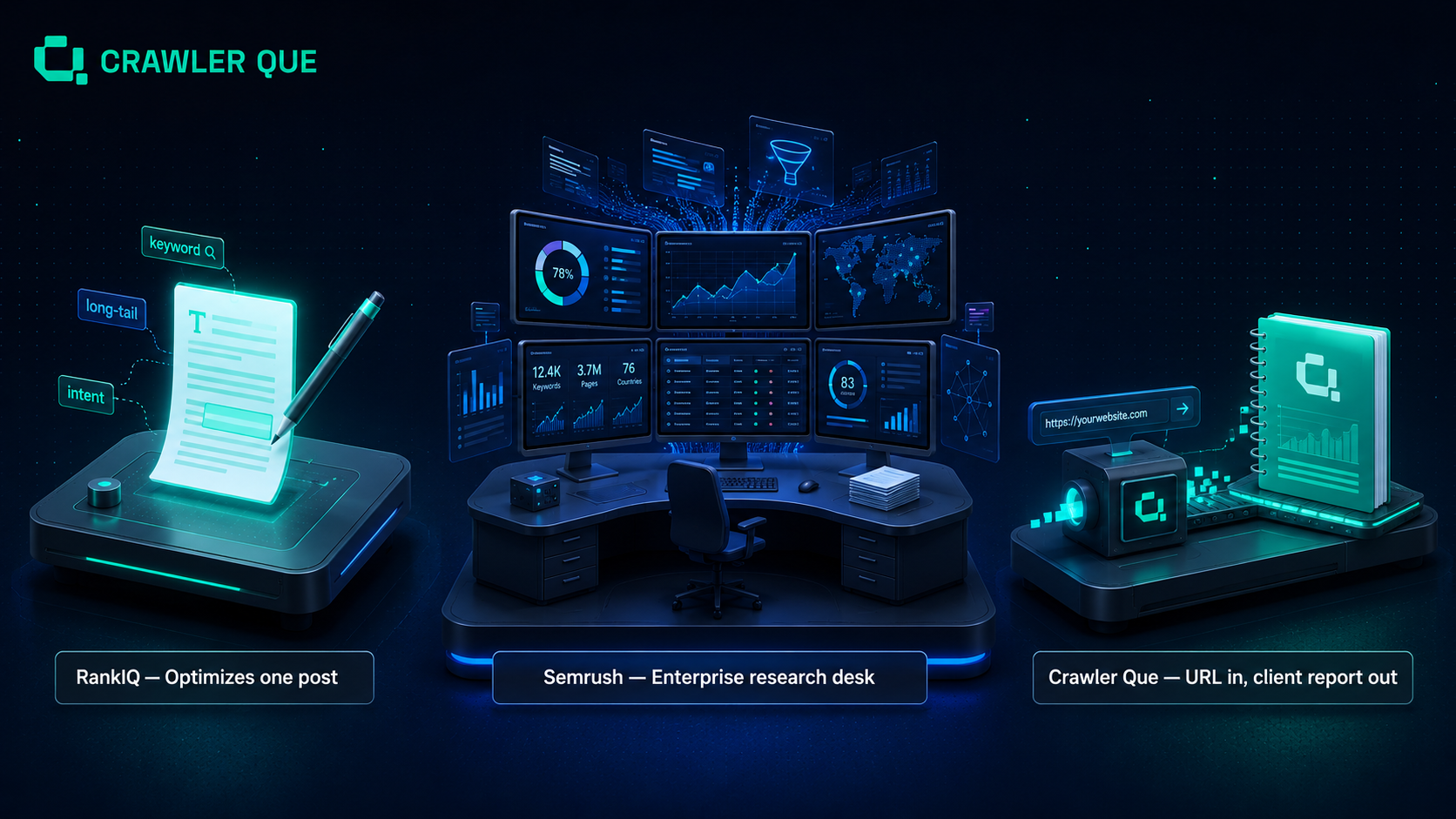
If you run a lean content team, the wrong pick costs you twice: once in subscription fees, and again in hours lost to a tool built for someone else's workflow.
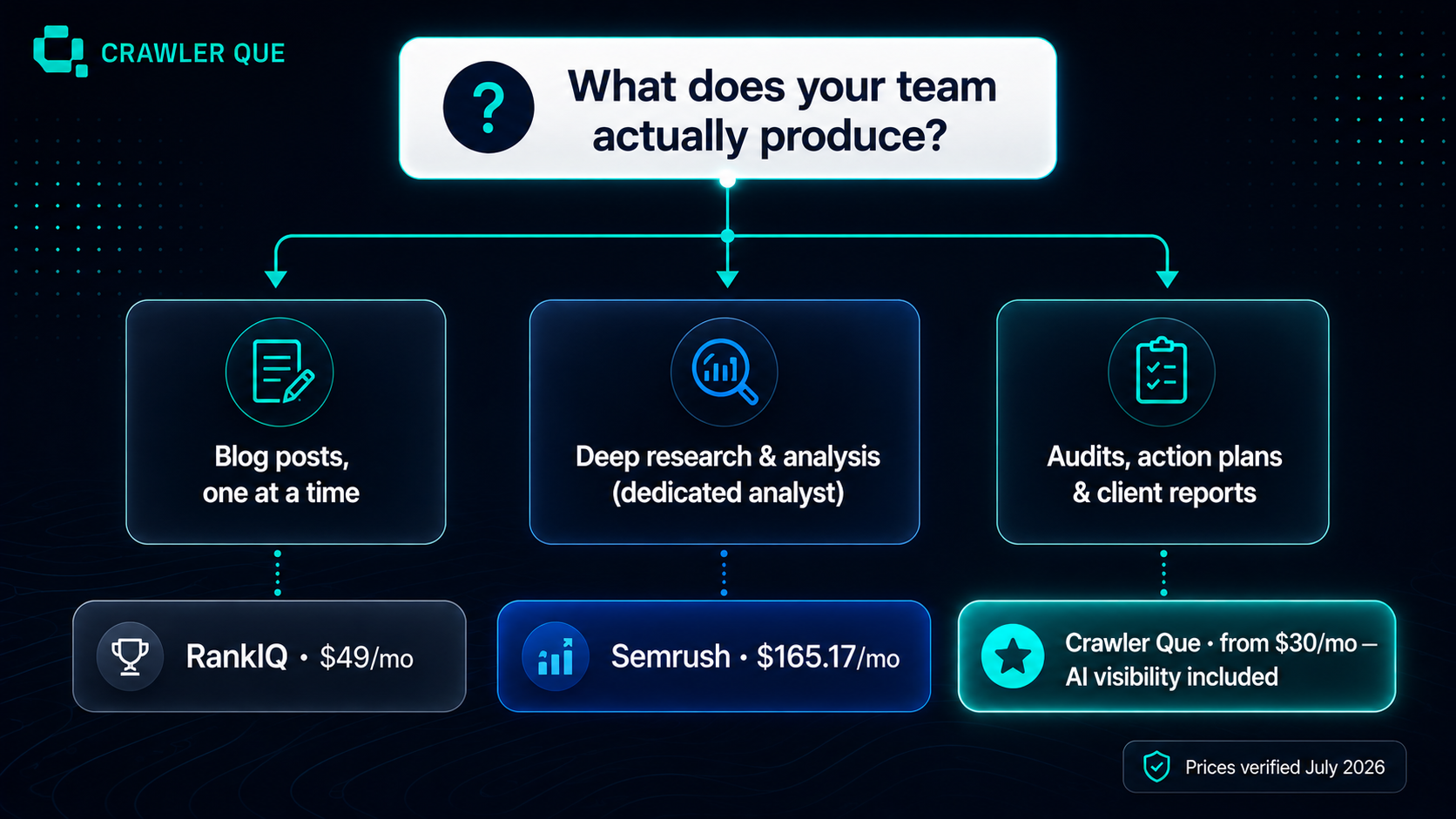
Choose RankIQ if you only write blog posts. Choose Semrush if you have a dedicated SEO analyst and a $250+/month budget. Choose Crawler Que if you need full site audits, AI visibility tracking, and client-ready reports from $30/month.
Compare plans →
The 30-Second Verdict
| Your situation | Best fit |
| Solo blogger optimizing posts one at a time | RankIQ |
| Team with a full-time SEO analyst and enterprise budget | Semrush |
| Lean content team that needs audits, AI visibility, and reports | Crawler Que |
| Agency or consultant delivering audits to clients | Crawler Que |
Now the reasoning: the sticker prices are misleading, and one line item changes the whole comparison.
What Is Each Tool Actually Built For?
RankIQ is a content optimizer for bloggers
Its core value is a hand-picked library of low-competition keywords across 500+ niches, plus an optimizer that tells you which topics to cover in a post. What it doesn't do: site audits, backlink analysis, technical SEO, Core Web Vitals, or AI visibility. It makes one page better; it can't tell you why your site underperforms
Semrush is an enterprise research suite
Keyword databases, backlink indexes, rank tracking, site audits, the deepest dataset in the industry. It's built for analysts who live in dashboards, and its pricing reflects that. AI visibility tracking exists, but as a separate $99/month add-on or inside the newer Semrush One bundles starting at $199/month.
Crawler Que is a deliverable engine
One URL in, a complete growth audit out: SEO intelligence, traffic modelling with confidence labels, Core Web Vitals, competitor intel, backlink authority, and an AI Search Visibility score, packaged into an 18-page white-label PDF. It's built for teams whose output is a report or an action plan, not a dashboard session.
Pricing: Sticker Price vs. What You'll Actually Pay
Here's where lean teams get burned. Published entry prices hide two multipliers: seats and add-ons.
| Cost factor (2026, monthly billing) | RankIQ | Semrush | Crawler Que |
| Entry plan | $49/mo | $165.17mo (Starter) | $30/mo (Starter) |
| Mid plan | ~$99/mo | $248.17/mo (Pro) | $99/mo (Agency) |
| Extra user seat | Single-user focus | +$45/mo (Starting Price) | 3 seats included on Agency |
| AI visibility tracking | Not available | +$99/mo add-on (or Semrush One from $199/mo) | Included on every plan |
| White-label client reports | Not available | Higher tiers/CRM add-ons | Included from $99/mo |
| Free option | None | Limited free tier | Full free audit, no signup |
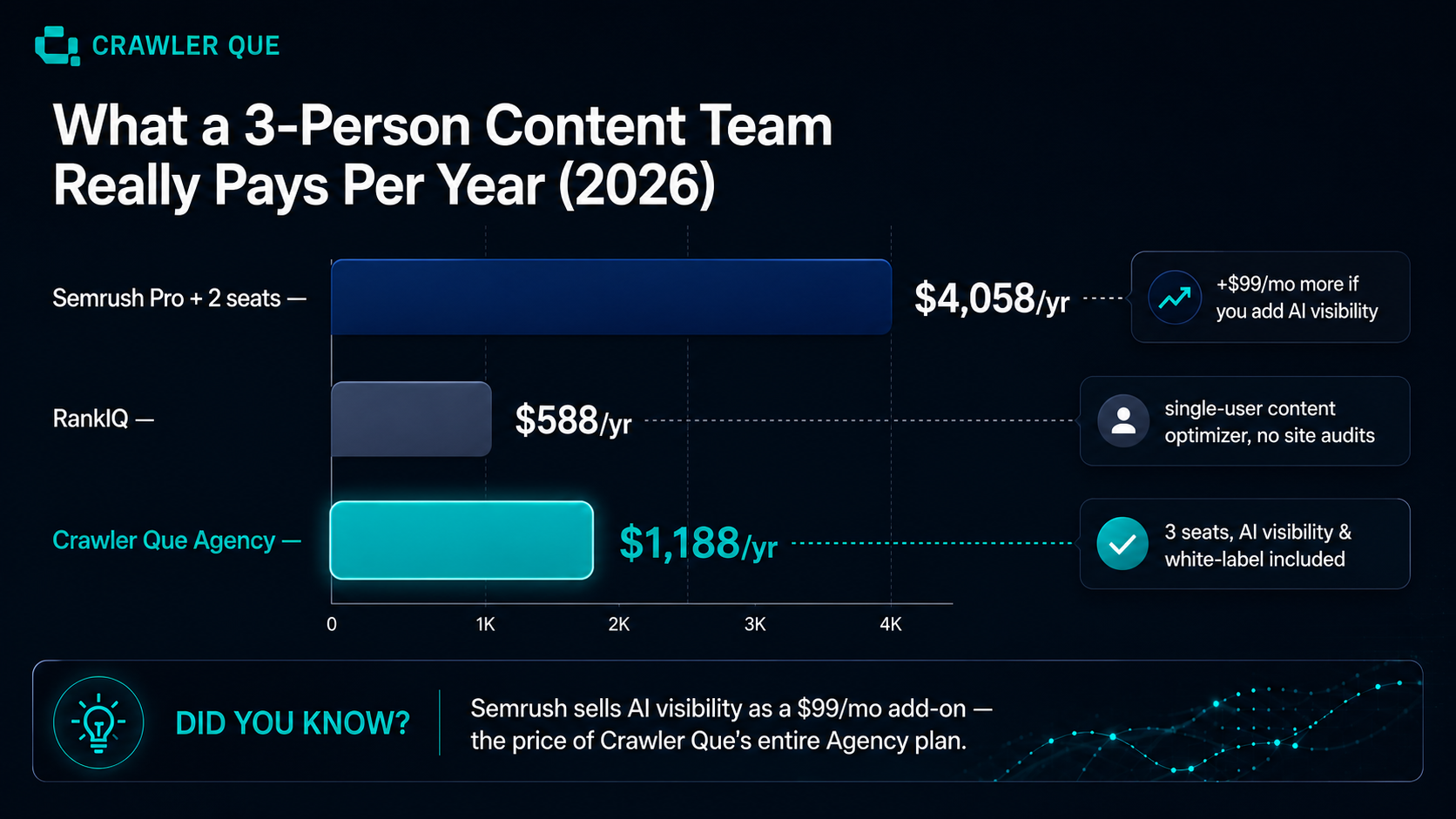
Run the real math for a three-person content team on Semrush Pro: $248.17 base + two extra seats at the $45 starting price = $338.17/month, or roughly $4,058/year, and that’s before any add-ons. The same team on Crawler Que's Agency plan pays $99/month flat, about $1,188/year, with AI visibility and white-label reporting already inside.
That's nearly 3.5x the cost for the Semrush setup, and it still doesn't include AI visibility.
And the single most telling line item: Semrush's AI Visibility Toolkit costs $99/month as an add-on. That's the entire price of Crawler Que's Agency plan, 40 audits, 3 seats, white-label PDFs, and AI visibility included.
Feature Comparison: Audit Depth, Content, and AI Visibility
| Capability | RankIQ | Semrush | Crawler Que |
| On-page content optimization | Excellent | Guru tier+ | Content quality scoring, not a writing optimizer |
| Keyword research | Curated library | Deepest database | Keyword footprint per audit |
| Full site audit | No | Yes | All 8 modules per run |
| Traffic estimation | No | Yes | With confidence labels |
| Backlink analysis | No | Deepest index | Authority overview |
| AI visibility (ChatGPT, Gemini, Perplexity) | No | Paid add-on | Included, scored 0–100 |
| Client-ready white-label PDF | No | Higher tiers | 18-page report |
| Learning curve | Very low | Steep: weeks to master | Low: paste URL, read report |
Two honest notes. If your entire workflow is "optimize this blog post," RankIQ's optimizer is genuinely strong, and Crawler Que won't replace it. And if you employ a full-time analyst who needs to slice a 25-billion-keyword database, Semrush's data depth is unmatched. The comparison isn't about which tool is "best"; it's about which one matches how a lean team actually works.
We ran the same exercise against Ahrefs in our Crawler Que vs SEMrush vs Ahrefs breakdown.
The Learning Curve Nobody Prices In
Subscriptions show up on invoices. Hours don't.
Semrush ships 50+ tools. Powerful, if someone on your team has the time to master them. For a content lead juggling writing, editing, and publishing, dashboard time is unbillable overhead. RankIQ sits at the opposite extreme: minutes to learn, but capped at post-level optimization forever.
The lean-team question is simpler: what output do you need, and how fast can you get it?
If the output is a prioritized action plan or a client report, an audit-first tool collapses hours of dashboard work into a 2-minute run.
See exactly what comes out in the sample report. It's also why consultants use the free audit as a sales opener: the tool produces the deliverable directly.
Frequently Asked Questions
What is the best SEO tool for 2026?
Is Semrush worth the money?
What's better than Semrush?
Which SEO tool is best for a small content team specifically?
Want to audit your website?
Run a Crawler Que audit to check SEO, Core Web Vitals, traffic signals, competitors, backlinks, recommendations, and AI search visibility.
Run website audit