
Website Audit
What Is an AI Website Audit Tool | And Why Your SEO Stack Needs One in 2026
An AI website audit tool runs a structured analysis of your website across multiple signals, SEO, speed, keywords, competitors, backlinks, and AI search visibility, and delivers the results as a clear, prioritized...
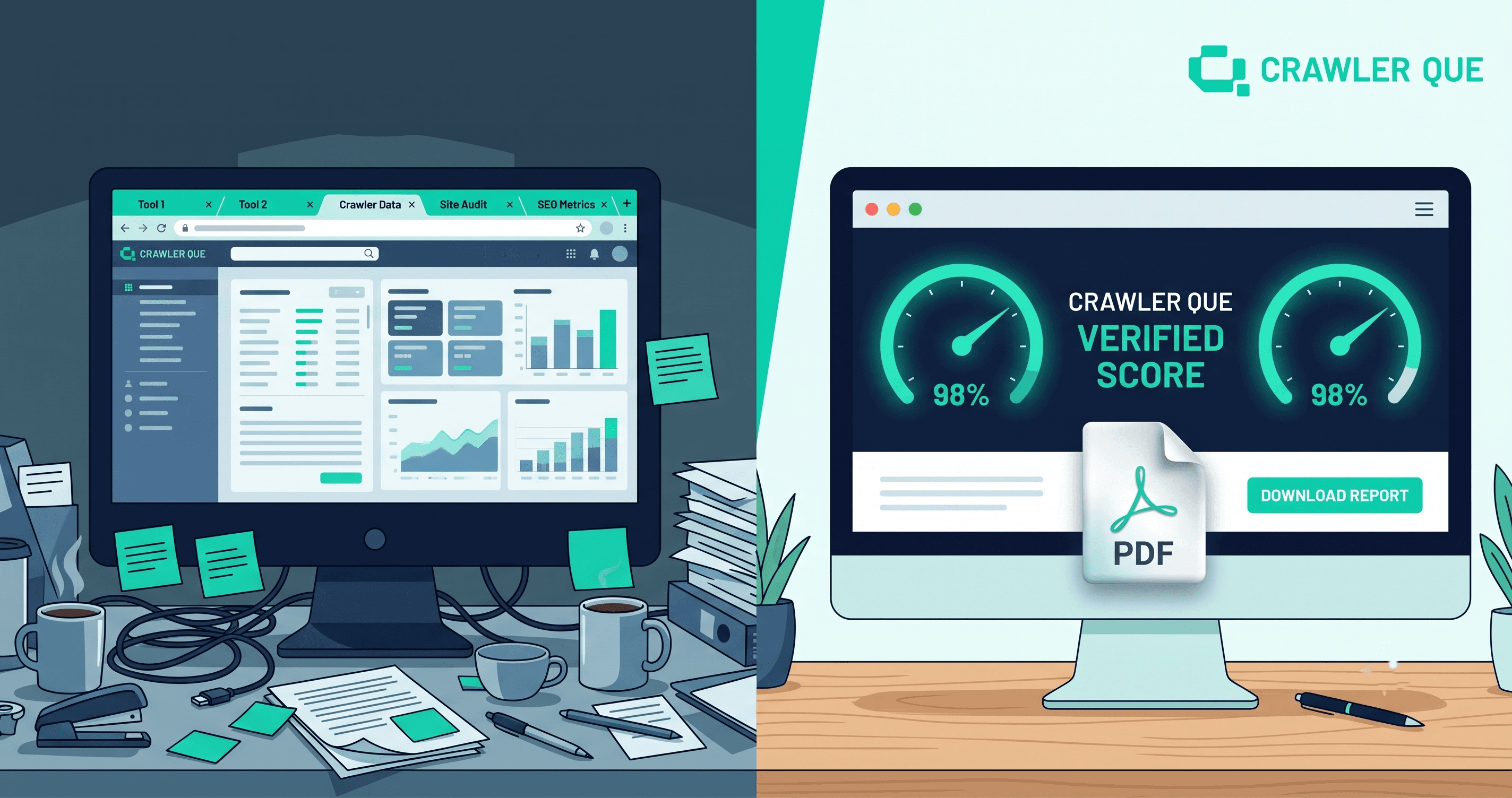
An AI website audit tool runs a structured analysis of your website across multiple signals, SEO, speed, keywords, competitors, backlinks, and AI search visibility, and delivers the results as a clear, prioritized report. Instead of opening five separate tools and manually assembling the picture, you get everything in one run.
In 2026, this matters more than it did two years ago. Search is no longer just Google. ChatGPT, Perplexity, and Gemini are answering buyer queries directly, and most websites have zero visibility into whether they appear in those answers. A modern audit tool needs to measure that too.
An AI website audit tool checks your site's technical health, content signals, traffic estimates, and AI search visibility in a single pass, then tells you what to fix first.
What Does a Website Audit Tool Actually Check?
Not all audit tools check the same things. The ones worth using in 2026 cover at minimum six signal layers:
Technical SEO: crawlability, robots.txt, sitemap, canonical tags, broken links, redirect chains, metadata gaps
On-page signals: title tags, H1 structure, meta descriptions, keyword density, structured data
Page speed and Core Web Vitals: LCP, CLS, FCP on mobile and desktop with specific fix recommendations
Keyword and traffic intelligence: what keywords the site ranks for, estimated traffic, and gaps vs competitors
Backlink authority: referring domains, trust signals, authority gap vs category leaders
AI search visibility: whether AI assistants mention the brand when asked buyer questions in the niche
Most legacy tools, SEMrush, Ahrefs, Screaming Frog, cover the first five to varying degrees. Almost none cover the sixth. That gap is now the most commercially significant blind spot in a typical agency or in-house SEO stack.
The 8 Modules Inside Crawler Que
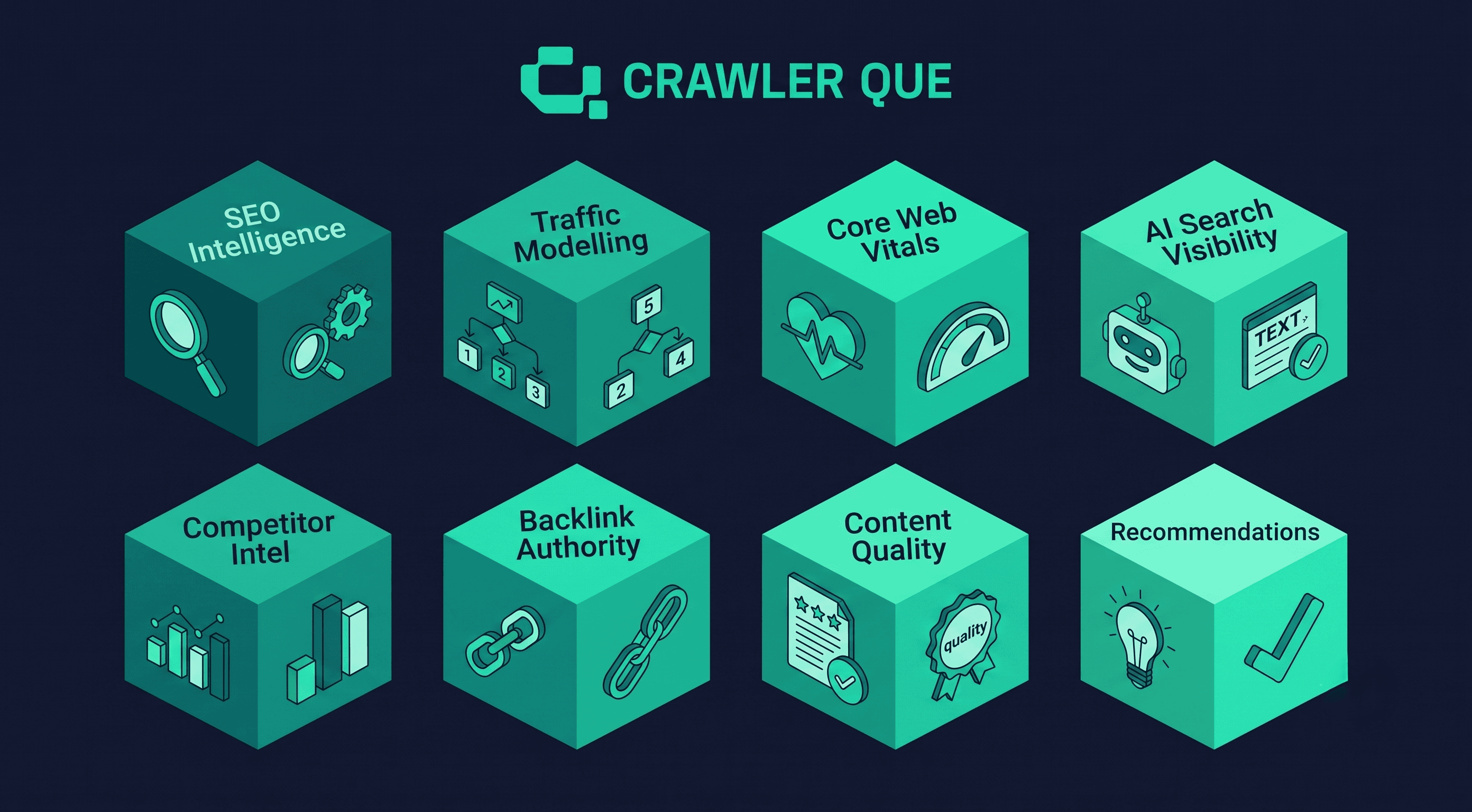
Crawler Que runs eight audit modules from a single URL input:
| Module | What It Checks |
| SEO Intelligence | Title, H1, meta, crawlability, keyword density, structured data signals |
| Traffic Modelling | CTR-curve traffic estimates across all ranked keywords with confidence scoring |
| Core Web Vitals | Google PageSpeed mobile and desktop scores with prioritized fix recommendations |
| AI Search Visibility | Brand mention testing across ChatGPT and Gemini with a 0–100 GEO readiness score |
| Competitor Intel | The domains competing for the same organic visibility and keyword gap analysis |
| Backlink Authority | Backlink profile, referring domains, and authority gap signals with trust scoring |
| Content Quality | Thin content detection, duplicate signals, and on-page content gap analysis |
| Recommendations & Roadmap | Prioritized action cards with owner, impact, timeline, and a 30/60/90-day execution plan |
Each module pulls from live data providers: Google PageSpeed Insights for Core Web Vitals, enterprise SEO data providers for keyword and backlink data, and Crawler Que's proprietary AI engine for recommendations and visibility scoring.
Why Running Five Separate Tools Is Costing You Time
The standard SEO stack for an agency in 2025 looked something like this: Ahrefs or SEMrush for keywords and backlinks, Screaming Frog for technical crawl, Google Search Console for impressions, and PageSpeed Insights for performance. That is four logins, four exports, and forty minutes of manual assembly before you can write a single recommendation.
For a freelancer with five clients, that overhead adds up to several billable hours every month. For an agency delivering monthly reports to twenty clients, it is a genuine operational bottleneck.
The problem isn't the data, it's the assembly time. Most SEO professionals already know what to look for. What they don't have is a tool that collects everything and prioritizes it automatically, so the deliverable is the report, not the research.
What Makes an Audit Tool "AI-Powered" in 2026
The term "AI" is used loosely in the tools market. There are two meaningful definitions:
1. AI-generated analysis and recommendations
The tool uses a language model to interpret audit data and produce plain-language findings instead of raw metric tables. This is what most "AI SEO tools" mean when they use the term.
2. AI search visibility measurement
The tool actively tests whether the audited brand appears in AI-generated search answers from ChatGPT, Perplexity, Gemini, and similar platforms. This is what Crawler Que's AI Search Visibility module does, and it is a fundamentally different signal from anything traditional SEO tools measure.
The first type improves reporting speed. The second type measures a search channel that is growing faster than any other and that almost no other tool in the market currently tracks.
Who Should Use an AI Website Audit Tool
The use case is different depending on who is running the audit:
Agencies need volume, consistency, and a white-label output. Running 40 audits per month and exporting branded PDFs is the core workflow. Crawler Que's Agency plan ($99/month) covers 40 full audits with white-label PDF reports and three user seats.
Freelance consultants need an affordable tool that produces a deliverable that justifies premium rates. Crawler Que's Starter plan ($30/month) includes 7 full audits per month with branded PDF export, enough for four or five regular clients.
In-house SEO teams need a shared starting point: one audit run at the start of each sprint, action cards assigned by the owner, and score tracking over time to show movement to leadership.
Business owners running their first audit need plain-language findings, not crawl logs. The priority is answering: "What is stopping my site from ranking, and what should I fix first?"
How to Run a Free Website Audit Right Now
Crawler Que lets you run a free audit on any URL without creating an account. The free audit includes a technical SEO scan, Core Web Vitals check, and on-page SEO signals, delivered in under two minutes.
To access all eight modules including AI Search Visibility, Traffic Modelling, Competitor Intel, and Backlink Authority, a paid plan is required. All plans include a 7-day free trial with all eight modules and three full audits, no charge until the trial ends.
Audit modules → See a sample report → View pricing →
Run a free website audit — no signup needed
See your SEO score, Core Web Vitals, and on-page signals in under 2 minutes. Upgrade for AI visibility, traffic modelling, competitors, and backlinks.
Start free — then from $30/mo
Want to audit your website?
Run a Crawler Que audit to check SEO, Core Web Vitals, traffic signals, competitors, backlinks, recommendations, and AI search visibility.
Run website audit