
GEO
What Is GEO (Generative Engine Optimization)? The Complete Guide for 2026
Generative Engine Optimization (GEO) is the practice of structuring your brand, content, and technical signals so that AI-powered search engines, ChatGPT, Perplexity, Gemini, and Google AI Overviews, cite and...
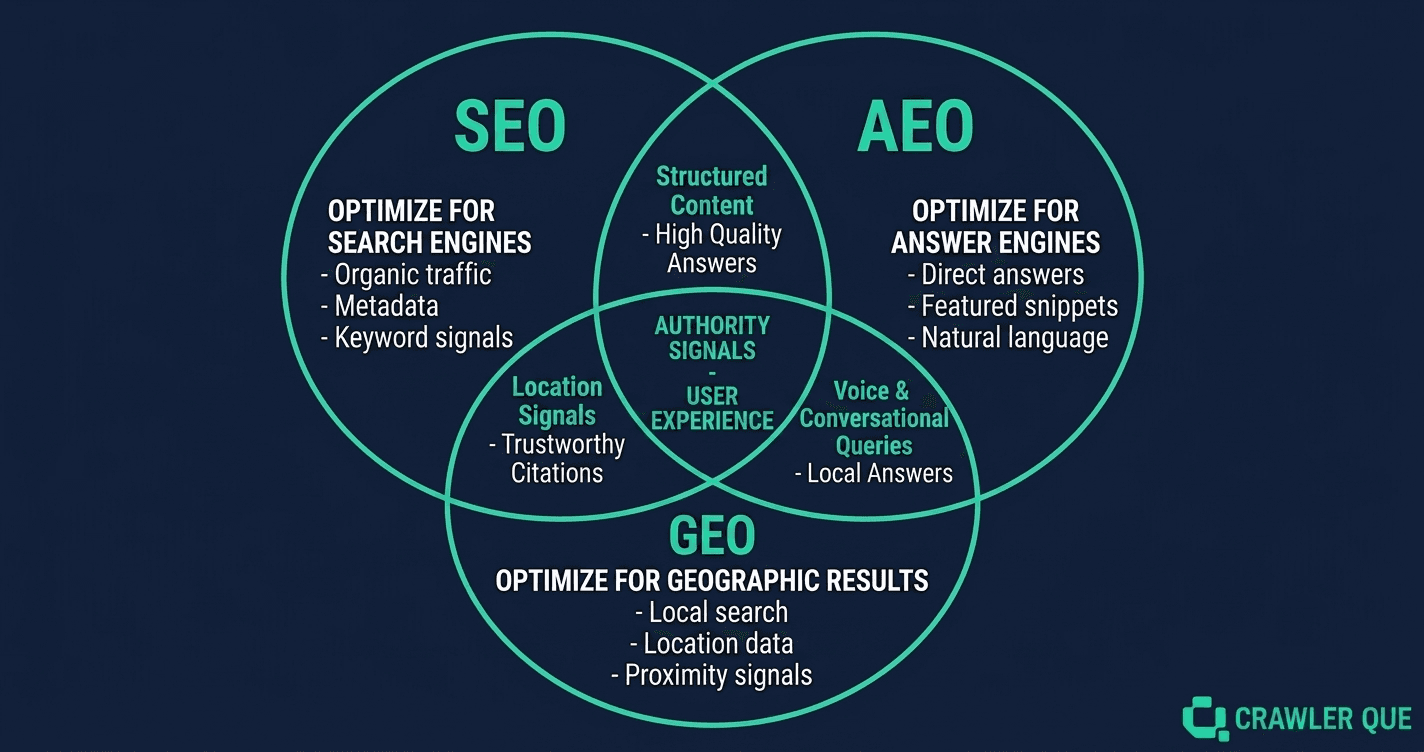
Generative Engine Optimization (GEO) is the practice of structuring your brand, content, and technical signals so that AI-powered search engines, ChatGPT, Perplexity, Gemini, and Google AI Overviews, cite and recommend your brand when users ask relevant questions.
Traditional SEO optimizes for a ranking position on a search results page. GEO optimizes for a citation inside an AI-generated answer. Those are different outputs, measured differently, influenced by different signals.
GEO = making your brand the answer AI gives when buyers ask questions in your category. It is not a replacement for SEO. It is the next layer built on top of it.
Why GEO Exists as a Separate Discipline
When a user types a query into Google, the result is a ranked list of pages. Visibility means appearing on page one. The mechanism is ranking position.
When a user asks ChatGPT "what is the best project management tool for a 5-person agency," the result is a synthesized answer. There is no page one. ChatGPT names specific products based on what it knows, what real-time web searches return, and what signals make a brand trustworthy enough to cite. The mechanism is citation, not ranking.
That shift requires a different optimization framework, and that framework is GEO.
GEO vs SEO: The Key Differences
| Dimension | SEO | GEO |
| Target surface | Google, Bing search results pages | ChatGPT, Perplexity, Gemini, AI Overviews |
| Success metric | Ranking position (1–10+) | Citation rate and mention frequency |
| Primary input | Keywords, backlinks, technical signals | Entity clarity, structured data, third-party citations |
| Output | A ranked page in a list | A named recommendation in an AI answer |
| User journey | User clicks to your site | AI answers on your behalf; user may never click |
| Measurement tool | Google Search Console, rank trackers | AI visibility scoring (e.g. Crawler Que) |
The two disciplines share a foundation. Strong organic SEO performance helps GEO because AI models frequently source from highly-ranked content. But GEO requires additional, specific signals that SEO alone does not generate.
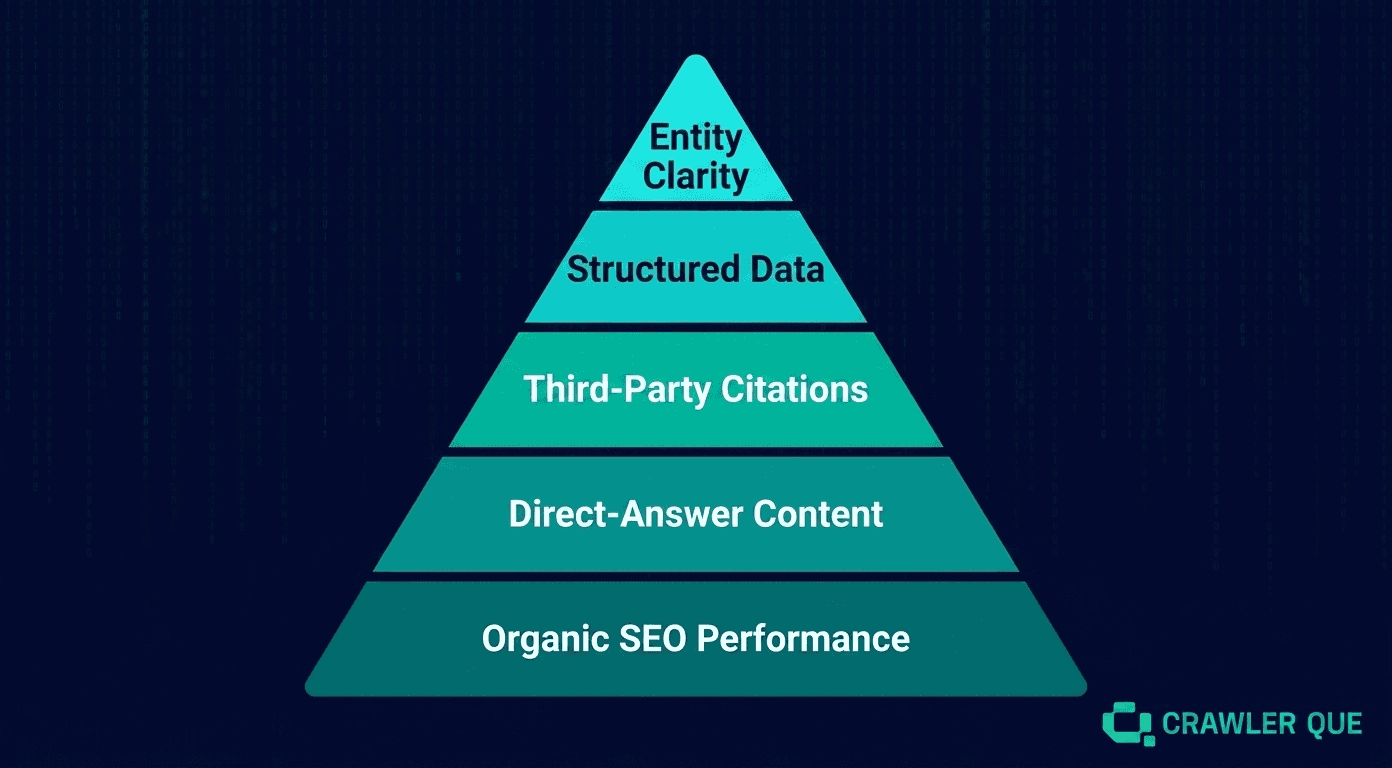
What Signals Drive GEO Performance
1. Entity clarity
AI models need to know what your brand is, what it does, and what category it belongs to. This means using consistent brand name, description, and category language across your website, your Google Business Profile, Wikipedia (if applicable), and third-party review platforms. Inconsistency confuses entity recognition.
2. Structured data markup
Schema markup, specifically Organization, FAQPage, Product, and Review schemas, gives AI models machine-readable signals about your brand. An Organization schema on your homepage explicitly tells AI parsers your name, description, URL, and social profiles. FAQPage schema marks your answer content as structured Q&A that AI can extract directly.
3. Third-party citations
AI models weight brands more heavily when they appear across authoritative third-party sources: G2, Capterra, industry review sites, editorial publications, and relevant directories. A brand that only exists on its own domain is harder for AI to verify as a credible recommendation.
4. Direct-answer content
Content structured to answer specific buyer questions, using the exact language buyers use in AI prompts, is more extractable by generative models. Instead of a page titled "Our Project Management Features," a page titled "How does [Brand] help agencies manage client projects?" directly matches the type of prompt an AI user would ask.
5. Organic SEO performance
AI Overviews and Perplexity both use live web search as part of their answer generation. Pages that rank well organically have a higher probability of being sourced in AI answers. GEO and SEO are not competing, SEO is the foundation that GEO is built on.
How to Measure GEO Performance
This is where most brands currently have a gap. There is no Google Search Console equivalent for GEO. The measurement requires actively querying AI platforms with buyer prompts and recording whether your brand appears, which is time-consuming to do manually across ChatGPT, Perplexity, Gemini, and Grok.
Crawler Que's AI Search Visibility module automates this process. It constructs relevant buyer prompts for the audited brand's category, queries multiple AI models, records brand appearance, and returns:
An AI Visibility Score from 0 to 100
A share of voice benchmark against organic competitors
A GEO readiness verdict identifying the specific missing signals
Prioritized recommendations for improving the score
This replaces what would otherwise be an hour of manual prompt testing across multiple AI platforms, and does it consistently every time an audit is run, making it trackable over time.
GEO Readiness: What the Verdict Means
The GEO readiness verdict in a Crawler Que audit assesses five specific infrastructure signals:
| Signal | What It Checks | Impact on GEO |
| Organization schema | Is the brand's entity data structured and machine-readable? | High |
| FAQPage schema | Is Q&A content marked up for AI extraction? | High |
| Third-party presence | Does the brand appear on authoritative external sources? | High |
| Direct-answer content | Are pages structured to answer specific buyer questions? | Medium |
| Technical crawlability for AI bots | Are AI crawlers (GPTBot, ClaudeBot, PerplexityBot) permitted in robots.txt? | Medium |
How Long Does GEO Take to Work
GEO improvements take longer to show results than on-page SEO changes because they depend partly on AI model update cycles and partly on accumulating third-party signals over time. A realistic timeline:
Technical fixes (schema, robots.txt): 2–8 weeks to be picked up by AI crawlers
Content restructuring: 4–12 weeks to influence AI answer generation
Third-party citation building: 3–6 months to accumulate sufficient signal weight
Score improvement (measurable): 6–16 weeks for the first meaningful score movement
Starting now matters. The brands that build GEO infrastructure in 2026 will have a compounding advantage as AI search usage continues to grow.
Measure first. Run a Crawler Que audit to get your current AI Visibility Score before deciding which GEO fixes to prioritize. The GEO readiness verdict will tell you exactly which signals are missing, so you are not guessing.
AI Search Visibility module → All audit modules → Check your GEO score free →
Check your brand's GEO readiness score, free
Find out if ChatGPT and Gemini recommend your brand. Get your AI Visibility Score and GEO readiness verdict in under 2 minutes.
Run AI visibility check →
Want to audit your website?
Run a Crawler Que audit to check SEO, Core Web Vitals, traffic signals, competitors, backlinks, recommendations, and AI search visibility.
Run website audit