
Organic Traffic
How to Estimate Your Website's Organic Traffic Without Google Analytics Access
Google Analytics access is not always available. You might be auditing a prospect's site before they become a client. You might be benchmarking a competitor. You might be doing due diligence on an acquisition. In all...
Google Analytics access is not always available. You might be auditing a prospect's site before they become a client. You might be benchmarking a competitor. You might be doing due diligence on an acquisition. In all of these cases, you need a traffic estimate, and GA is off the table.
The method for estimating organic traffic without analytics access is called CTR-curve traffic modelling. It is the same methodology used by Ahrefs, SEMrush, and Crawler Que's Traffic Modelling module, and understanding how it works helps you interpret the estimates correctly and explain them to clients.
CTR-curve traffic modelling estimates organic traffic by identifying all keywords a site ranks for, applying position-based click-through rates to each keyword's search volume, and summing the result. The accuracy depends on keyword coverage and how accurately the ranking data reflects real positions.
How CTR-Curve Traffic Modelling Works
The model has four inputs:
Keyword footprint: every keyword the domain ranks for, from position 1 to position 100+
Search volume per keyword: how many times that keyword is searched per month
Ranking position: where the site currently ranks for that keyword
CTR curve: the average click-through rate for each ranking position based on industry data
The formula for each keyword is:
Estimated traffic = Search volume × CTR for that position
Sum this across all ranked keywords and you have an estimated total monthly organic traffic figure.
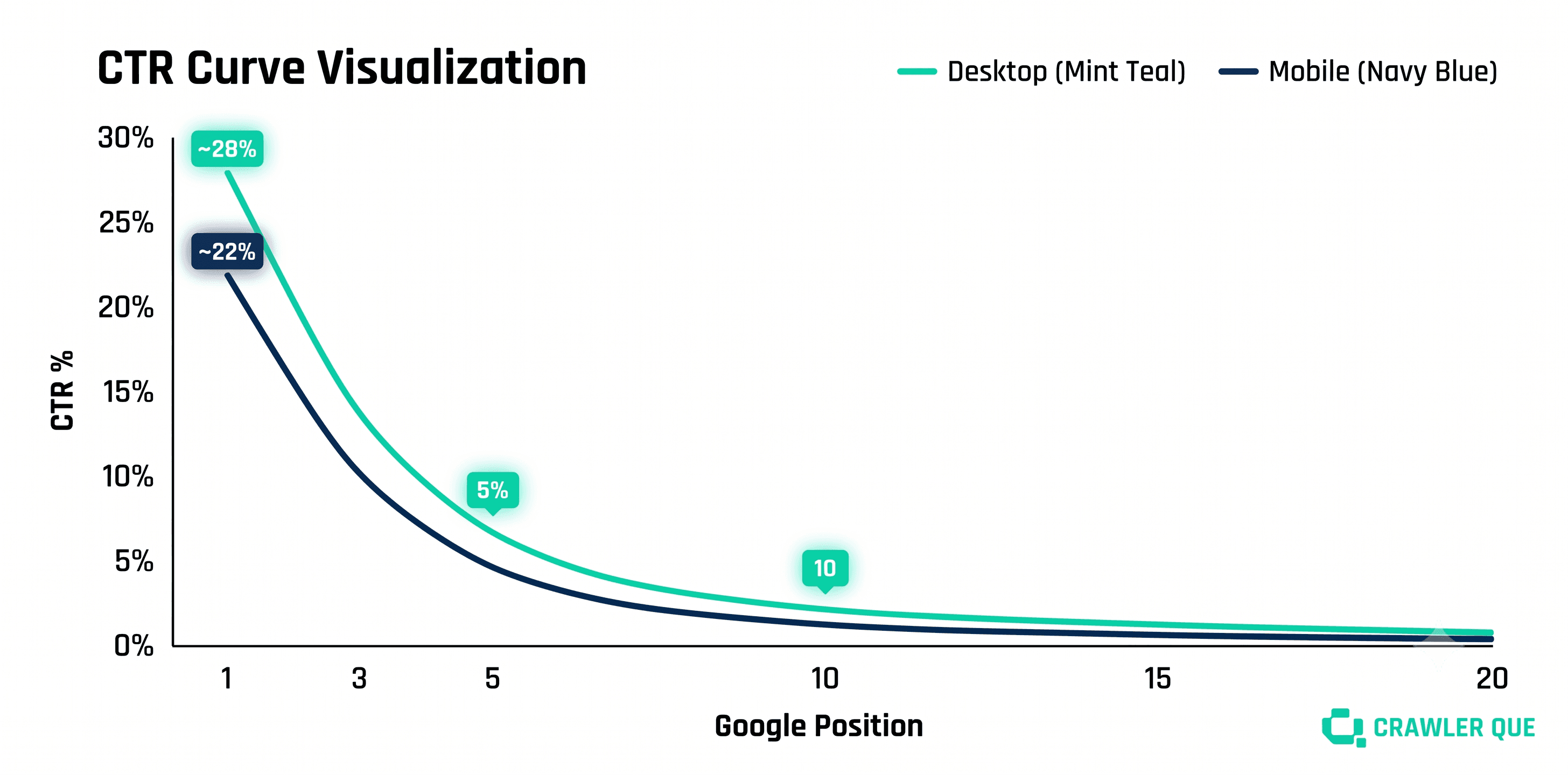
The CTR Curve: What Click-Through Rates Actually Look Like
| Google Position | Average CTR (desktop) | Average CTR (mobile) |
| 1 | 27–30% | 24–26% |
| 2 | 15–17% | 12–14% |
| 3 | 11–13% | 9–11% |
| 4 | 8–9% | 7–8% |
| 5 | 6–7% | 5–6% |
| 6–10 | 3–5% | 2–4% |
| 11–20 (page 2) | 1–2% | 0.5–1% |
| 21–50 | 0.3–0.8% | 0.2–0.5% |
| 51–100 | 0.1–0.3% | 0.05–0.2% |
These rates vary significantly based on query type. Navigational queries (brand searches) have much higher CTRs for position one. Informational queries with featured snippets have lower CTRs because Google answers the question directly in the SERP. Commercial queries with shopping ads or rich results have lower organic CTRs across all positions.
Why Estimates Are Always Approximations
Traffic modelling produces estimates, not exact figures. Three sources of inaccuracy are always present:
1. Keyword coverage gap
No third-party tool captures 100% of the keywords a site ranks for. Ahrefs, SEMrush, and enterprise SEO data providers all miss long-tail keywords with very low individual search volumes. A site ranking for 50,000 long-tail keywords at low volumes will be underestimated by any model that only captures the top 5,000.
2. Ranking position variance
Rankings change daily and vary by geography, device, and user history. The position recorded in a keyword database is a snapshot, actual positions at the moment of a given search may be higher or lower.
3. CTR curve variation by query type
Applying a generic CTR curve to all keywords flattens out real variation. A site ranking position one for a branded navigational query will receive a much higher CTR than position one for a broad informational query with AI Overview coverage.
This is why Crawler Que's Traffic Modelling module attaches confidence labels to its estimates. A site with a large, well-ranked keyword footprint in a reliable keyword database gets a high-confidence estimate. A site with sparse keyword data gets a clearly labeled low-confidence estimate, because presenting a thin-data estimate as a precise figure would be misleading.
How to Use Traffic Estimates in Client Conversations
The most useful application of traffic estimates is not the absolute number, it is the comparison. Showing a client that their site attracts an estimated 2,400 organic visits per month while their top competitor attracts an estimated 14,000 creates immediate, actionable context. The gap is the opportunity.
Similarly, showing a client that their current traffic is concentrated in positions 6–10 (where CTR is 3–5%) and that moving five keywords to positions 1–3 (where CTR is 11–27%) would roughly triple estimated traffic, without needing any new content, is a clear, compelling ROI argument for SEO investment.
Comparing a Site's Traffic to Competitors Without GA
Crawler Que's AI Search Visibility Competitor Intel module identifies the domains that compete for the same organic visibility as the site being audited. The Traffic Modeling module applies the same click-through rate (CTR) estimation to all these competing domains simultaneously, generating comparable traffic figures for the entire competitive set.
This means you can generate a traffic benchmark for an entire competitive landscape, including the audited site, its top ten organic competitors, and the estimated keyword gap between them, from a single URL input, in under two minutes, without GA access on any of those domains.
The key disclosure for clients: These are modelled estimates based on keyword ranking data and average CTR curves, not analytics measurements. They are directionally accurate and useful for benchmarking and prioritization, but should not be presented as verified traffic figures.
Traffic Modelling module → See sample traffic report → Try Traffic Modelling free →
Estimate any site's organic traffic, free trial, no signup
Crawler Que's Traffic Modelling module estimates monthly organic traffic with confidence scoring. 7-day free trial includes all 8 modules.
Try Traffic Modelling free →
Frequently Asked Questions
How do I estimate organic traffic without Google Analytics access?
Is there a Google traffic estimator tool?
How accurate are organic traffic estimators?
Can I estimate a competitor's website traffic?
What's the difference between a traffic estimator and a traffic calculator?
Want to audit your website?
Run a Crawler Que audit to check SEO, Core Web Vitals, traffic signals, competitors, backlinks, recommendations, and AI search visibility.
Run website audit