
AI Visibility
AI Search Visibility Explained | How to Find Out if ChatGPT Recommends Your Brand
AI search visibility is a measure of how often and how prominently a brand appears when AI assistants like ChatGPT, Perplexity, and Gemini are asked buyer questions in that brand's category. A business with high AI...
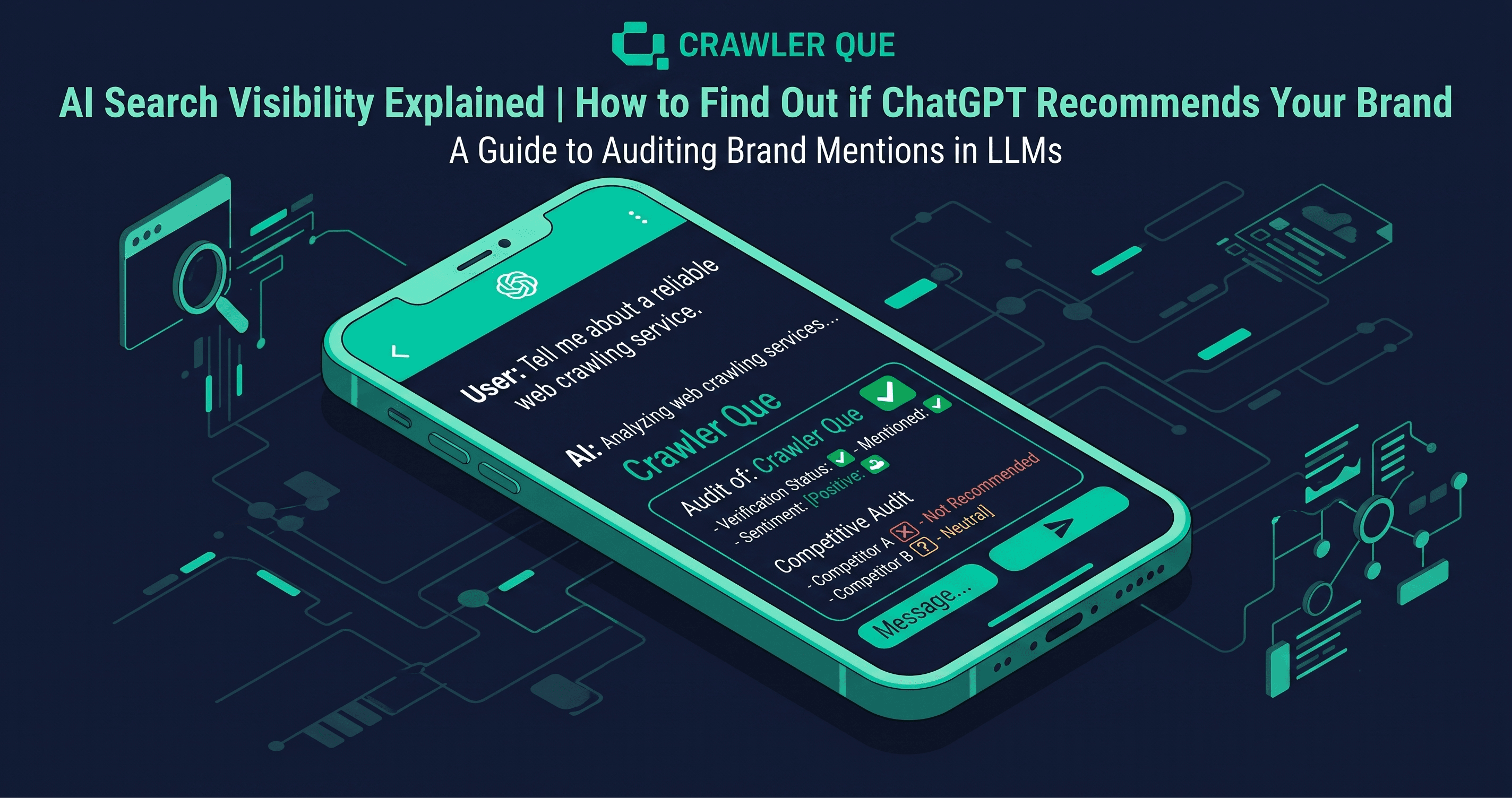
AI search visibility is a measure of how often and how prominently a brand appears when AI assistants like ChatGPT, Perplexity, and Gemini are asked buyer questions in that brand's category. A business with high AI search visibility gets recommended by AI. One with low visibility gets replaced by a competitor in the answer, without ever knowing it happened.
This is now a measurable signal rather than just a theory. The AI Search Visibility module of Crawler Que tests brand mentions across various AI models, including tools like the ChatGPT visibility checker. It does this by using realistic buyer prompts and provides a score from 0 to 100. This post will clarify what that score measures, why it is important, and what actions to take if the score is low.
AI search visibility measures whether AI assistants recommend your brand when buyers ask questions in your category. Crawler Que scores this 0–100 and shows you how you compare to your competitors.
Why AI Search Visibility Is Now a Commercial Priority
ChatGPT reached over 800 million weekly active users in 2026. Google AI Overviews appear in more than 25% of all searches. Perplexity is growing at a rate that makes it one of the fastest-adopted search interfaces in history.
When a buyer asks ChatGPT "what is the best CRM for a 10-person sales team," ChatGPT does not return a list of blue links. It names specific products. Those products are the ones with AI search visibility. The brands not mentioned are invisible to that buyer at the exact moment they are making a decision.
Traditional SEO tools, SEMrush, Ahrefs, Google Search Console, measure ranking positions on Google. None of them tell you whether you appear in AI-generated answers. That is the gap AI Search Visibility scoring fills.
What Crawler Que's AI Visibility Module Measures
Brand mention testing
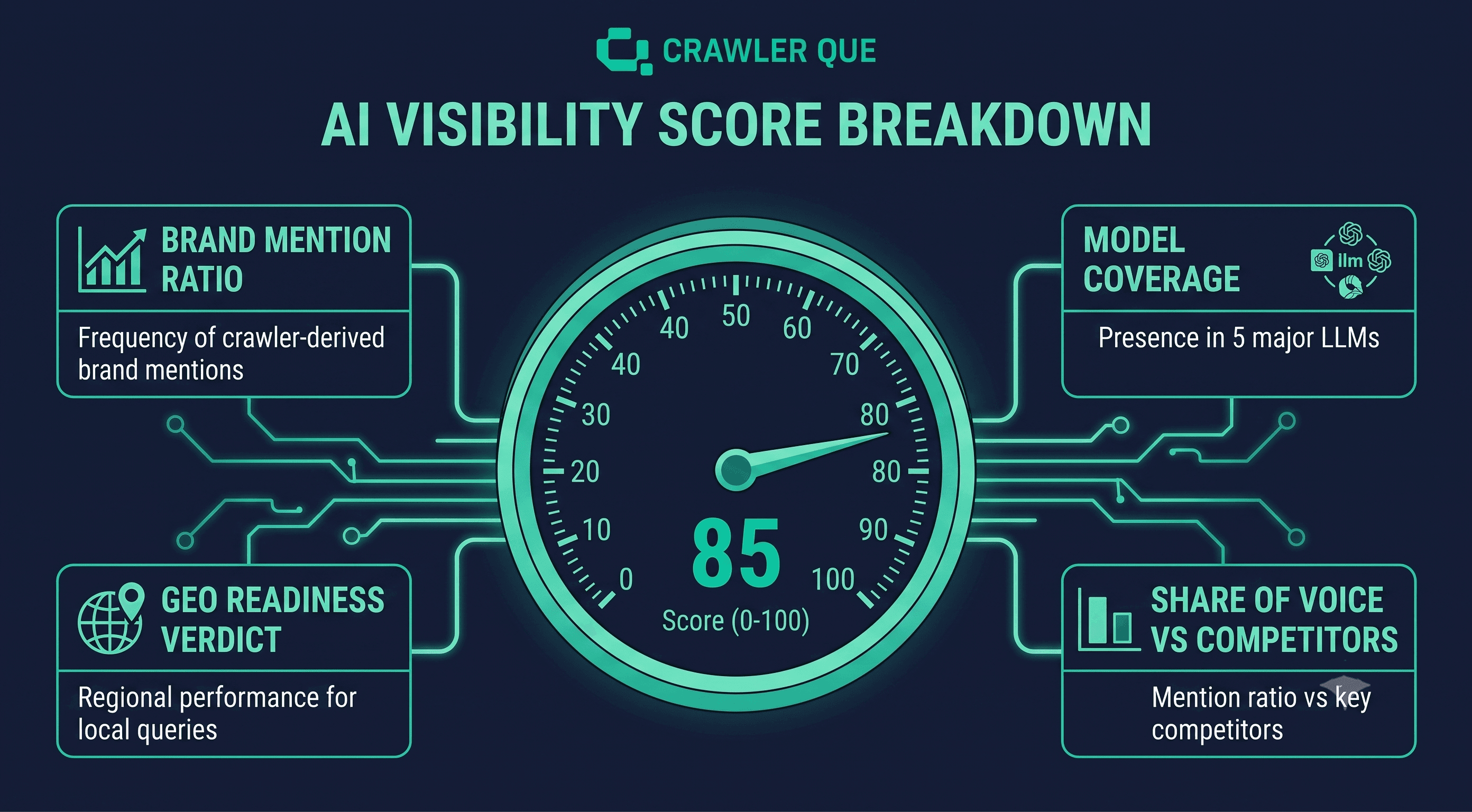
Crawler Que queries measure your brand visibility in ChatGPT across multiple AI models using realistic buyer prompts constructed for the audited brand's niche. For example, if auditing a project management SaaS, the prompts would be things like "best project management tools for remote teams" or "what software do agencies use to manage client projects." The module records whether the brand appears in the AI responses and under what conditions.
AI Visibility Score (0–100)
The score is built from two factors: mention ratio (how often the brand appeared across all prompts tested) and model coverage (how many AI platforms mentioned the brand). An honest confidence label is attached, if the sample is thin, that is stated explicitly rather than presenting a low-sample result as definitive.
Share of voice
The module benchmarks the audited brand against the organic competitors identified in the Competitor Intel module to compare your competitors’ AI visibility. This shows not just raw visibility but relative visibility. A brand might have an absolute score of 35, but if competitors average 12, that is a strong position. If competitors average 68, it is a warning signal.
GEO readiness verdict
GEO stands for Generative Engine Optimization. The GEO readiness check identifies the specific technical and content signals that determine whether AI models can confidently cite a brand: entity signals, schema markup, FAQ content, and third-party citations. The verdict tells you whether the infrastructure is in place, and if not, exactly what is missing.
What Factors Determine AI Search Visibility
AI models cite brands based on what they have learned from the web and what real-time search returns when they look up a query. The following factors are the most consistently significant:
| Factor | Why It Matters | Fixable? |
| Google organic ranking | AI models frequently pull from top-ranking content when generating answers | Yes, SEO improvement |
| Third-party mentions | Review sites, directories, and editorial coverage signal brand credibility to AI | Yes, link building and PR |
| Schema markup | Structured data (Organization, FAQPage, Product) helps AI parse brand identity | Yes, developer task |
| FAQ and Q&A content | Content that directly answers buyer questions is more extractable by AI | Yes, content work |
| Entity consistency | Brand name, description, and category used consistently across the web | Yes, content audit |
| Model training data | Older, established brands have advantage; newer brands need accelerated signals | Partial, timeline factor |
Why SEMrush and Ahrefs Cannot Tell You This
SEMrush and Ahrefs are built to measure one specific thing: how a website performs in traditional search engine results pages. They are excellent at that. They track keyword rankings, crawl for technical issues, and analyze backlink profiles, all against the Google index.
AI-generated answers are not the Google index. ChatGPT does not rank pages. Perplexity does not return position 1 through 10 in the way Google does. The measurement framework for AI search visibility is entirely different, and it requires actively querying AI models with buyer prompts, not scraping a search engine results page.
This is why Crawler Que's AI visibility module is a genuine differentiator. It is not a rebranding of an existing metric. It is a different measurement methodology for a different search channel.
How to Improve Your AI Search Visibility Score
If your score is low, your brand may not appear in ChatGPT. The GEO readiness verdict in the audit will identify specific gaps. Step-by-step checks across ChatGPT, Perplexity, and Gemini are necessary. The most common solutions include:
Add Organization schema to your homepage: this gives AI models a structured signal of your brand name, description, and category.
Add FAQPage schema to key landing pages: AI models extract question-answer pairs more reliably when they are marked up structurally.
Earn mentions on third-party review platforms: G2, Capterra, Trustpilot, and editorial publications all contribute to AI brand recognition.
Publish content that directly answers buyer questions: using the exact language buyers use when asking AI assistants, not keyword-stuffed titles.
Improve your Google organic ranking: AI models still heavily weigh content that ranks well organically. A strong SEO foundation feeds GEO performance.
The fastest starting point: Run a free Crawler Que audit on your site. The AI visibility score will show you exactly where you stand versus competitors, and the GEO readiness verdict will tell you the three highest-impact fixes for your specific situation.
AI Search Visibility module → All audit modules → Pricing →
Check your brand's AI search visibility, free
Run a free audit and see your AI Visibility Score, GEO readiness verdict, and competitor share of voice. No signup required for the basic audit.
Frequently Asked Questions
How do I check my AI search visibility?
Is my business visible in ChatGPT?
What affects whether a business appears in ChatGPT or AI-powered search results?
How can I see if AI search engines mention my brand or website?
How is AI search visibility different from Google rankings?
Want to audit your website?
Run a Crawler Que audit to check SEO, Core Web Vitals, traffic signals, competitors, backlinks, recommendations, and AI search visibility.
Run website audit