
AI Visibility
Why Your Brand Is Invisible in ChatGPT (Even Though It Ranks on Google)
Your brand can rank on page one of Google and still never appear in ChatGPT because the two systems decide what to surface in completely different ways. This is the heart of why your brand is not showing in ChatGPT: G...
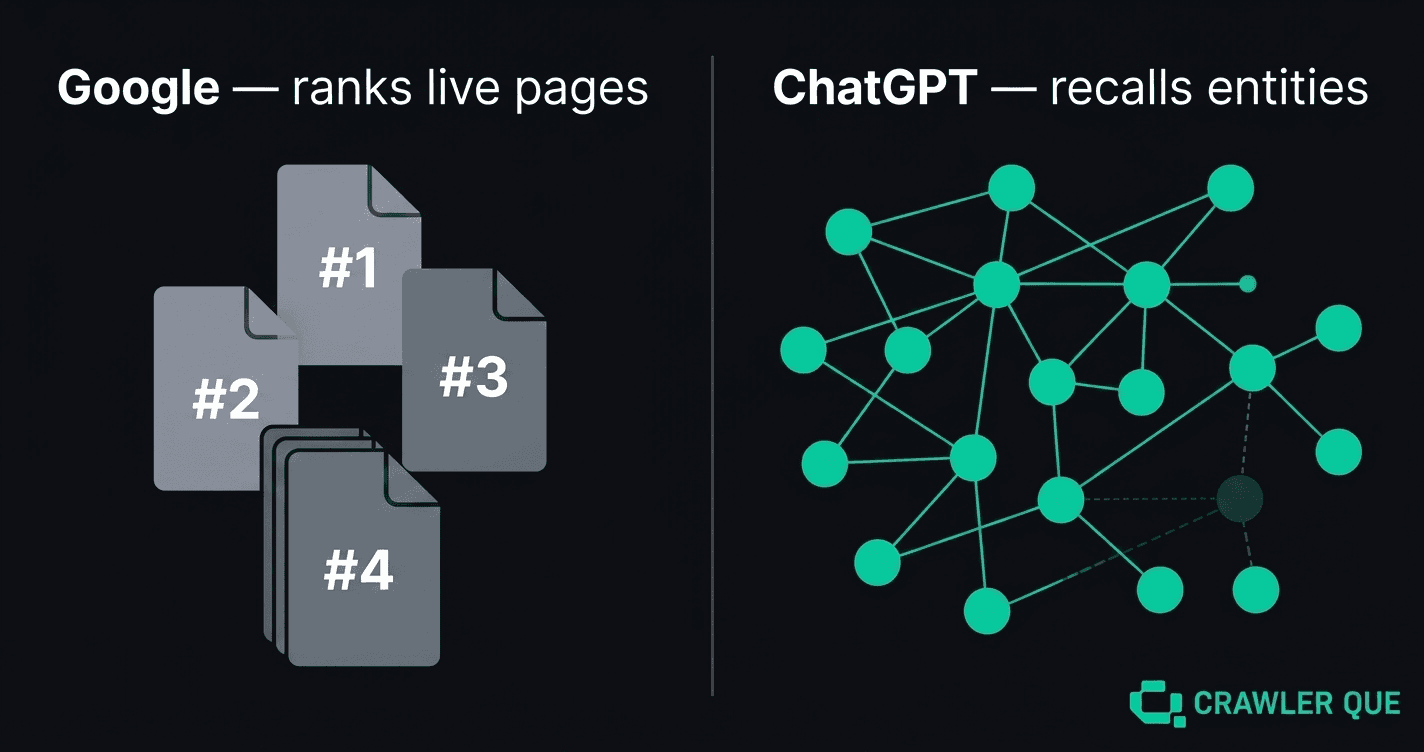
Your brand can rank on page one of Google and still never appear in ChatGPT because the two systems decide what to surface in completely different ways. This is the heart of why your brand does not have ChatGPT visibility: Google ranks live pages against a query, while ChatGPT reconstructs an answer from what it learned in training plus what it can retrieve and trust in the moment. If you aren't a clear, well-cited entity in those sources, the model has no reason to name you.
A brand can rank on Google yet stay invisible in ChatGPT because Google ranks live pages while ChatGPT recalls trusted entities. The usual causes are weak entity recognition, key facts that aren't in structured form, few third-party citations, blocked AI crawlers, and training-data lag, most of which are fixable.
Google ranks pages; ChatGPT recalls entities
A search engine crawls the live web and orders pages for each query. A language model builds answers from a compressed memory of its training data plus, where available, real-time retrieval, and it leans on entities it can identify and trust. Ranking well signals quality, but it doesn't automatically make you a recognisable entity the model will cite. That mismatch is why strong SEO and weak AI visibility can sit side by side.
What affects whether a business appears in ChatGPT
Reason 1: You're not a recognised entity
If the model can't confidently connect your brand name to a clear description of what you do, it treats you as ambiguous and leaves you out. Consistent naming, a crisp category description, and matching signals across the web are what make you legible.
Reason 2: Your key facts aren't in extractable form
Facts buried in images, inconsistent copy, or unstructured pages are hard for a model to lift cleanly. Structured data and plainly stated facts make your details easy to extract and reuse in an answer.
Reason 3: Nobody credible mentions you
Models weigh third-party corroboration heavily. If reputable sites, directories, and publications in your category don't reference you, there's little external signal telling the model you belong in the answer.
Reason 4: You blocked or confused the AI crawlers
If your robots rules block AI crawlers, or key content only renders through heavy JavaScript, the systems that feed retrieval may never read you properly. An AI-oriented crawlability check catches this quickly.
Reason 5: Training-data lag
Models learn on snapshots taken at a point in time. A newer brand, a rebrand, or a recent pivot may simply predate what the model absorbed: which is why retrieval signals and fresh third-party mentions matter while the next training cycle catches up.
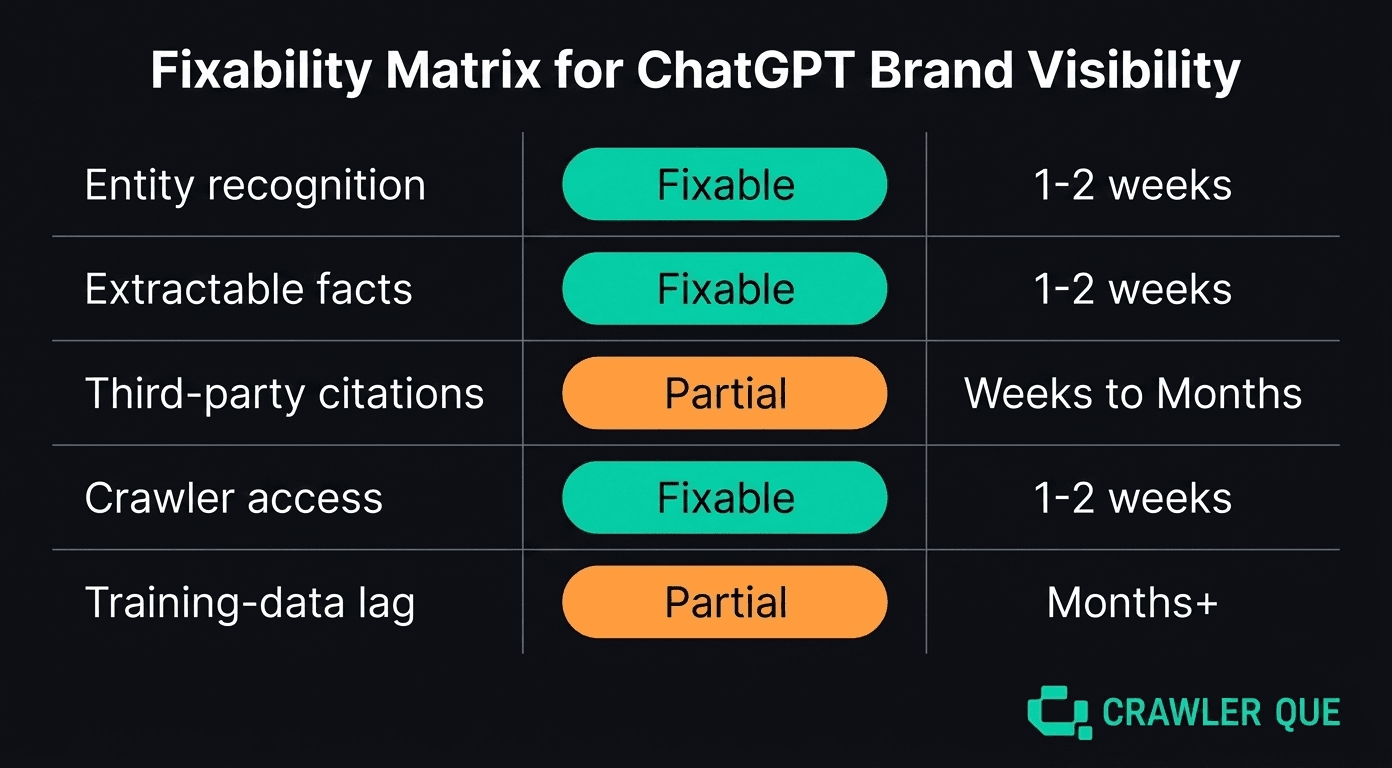
Which of these you can actually fix
| Reason | Fixable? | Rough timeline |
| Weak entity recognition | Yes | Weeks, consistent naming and description |
| Facts not extractable | Yes | Days to weeks, schema and clear copy |
| Few third-party citations | Partly | Months, earned mentions build slowly |
| Blocked / unreadable to crawlers | Yes | Days, fix robots rules and rendering |
| Training-data lag | Indirect | Bridge it with retrieval + citation signals |
How to test whether AI actually understands your brand
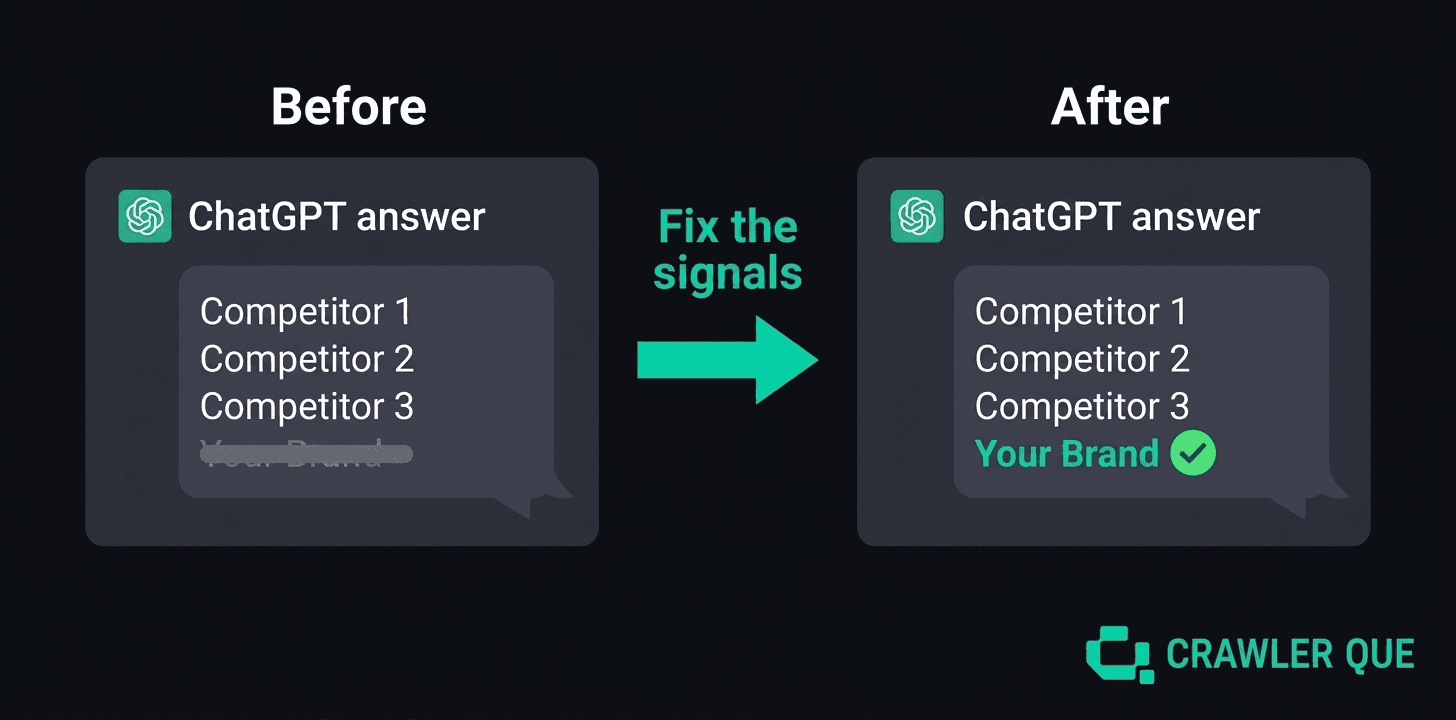
Don't assume, check. Ask ChatGPT to describe your brand and to recommend options in your category, and watch two things: whether it names you, and whether the description is accurate. A wrong description is its own problem, because a confidently incorrect mention can cost you more than silence.
Crawler Que's AI Visibility module runs that test at scale: buyer-intent prompts across multiple models, scored for mention ratio and model coverage, with a GEO readiness verdict that maps directly onto the five reasons above, so you see not just that you're invisible, but which signal is causing it.
Common questions
My brand shows on Google but is invisible when people ask ChatGPT why?
Because ranking a page and being a trusted entity are different achievements. Google can rank your page while ChatGPT, lacking clear entity and citation signals, leaves you out of the answer entirely.
Will fixing this hurt my normal SEO?
No, the fixes are additive. Clear entities, structured data, credible mentions, and crawlability all support traditional SEO too. GEO sits on top of good SEO rather than replacing it.
How long until my brand starts showing up in ChatGPT?
Expect weeks, not days, crawlability and schema fixes register fastest, while entity clarity and third-party citations build over months. Retrieval-based signals can surface sooner than the next training cycle catches up.
Does ChatGPT pull from live pages or only its training data?
Both, it recalls what it learned in training and, where retrieval is available, pulls from live sources in the moment. That's why fresh citations and readable pages matter even for facts the model hasn't been trained on yet.
ChatGPT describes my brand incorrectly, is that worse than being invisible?
Often yes, because a confident wrong answer actively misleads buyers, while silence just leaves a gap. Fixing it is the same work: clear entity signals and consistent, extractable facts give the model something accurate to repeat.
Find the exact signal keeping you out of AI answers
Run a free AI visibility check and get a GEO readiness verdict for your site.
Find your AI visibility gaps free
Want to audit your website?
Run a Crawler Que audit to check SEO, Core Web Vitals, traffic signals, competitors, backlinks, recommendations, and AI search visibility.
Run website audit