
SEO
Track Brand Visibility Across ChatGPT, Claude & Gemini at Once (2026 Guide)
Stop checking ChatGPT, Claude, and Gemini one tab at a time. See how to track brand visibility across AI platforms in one dashboard, with real share-of-voice data.
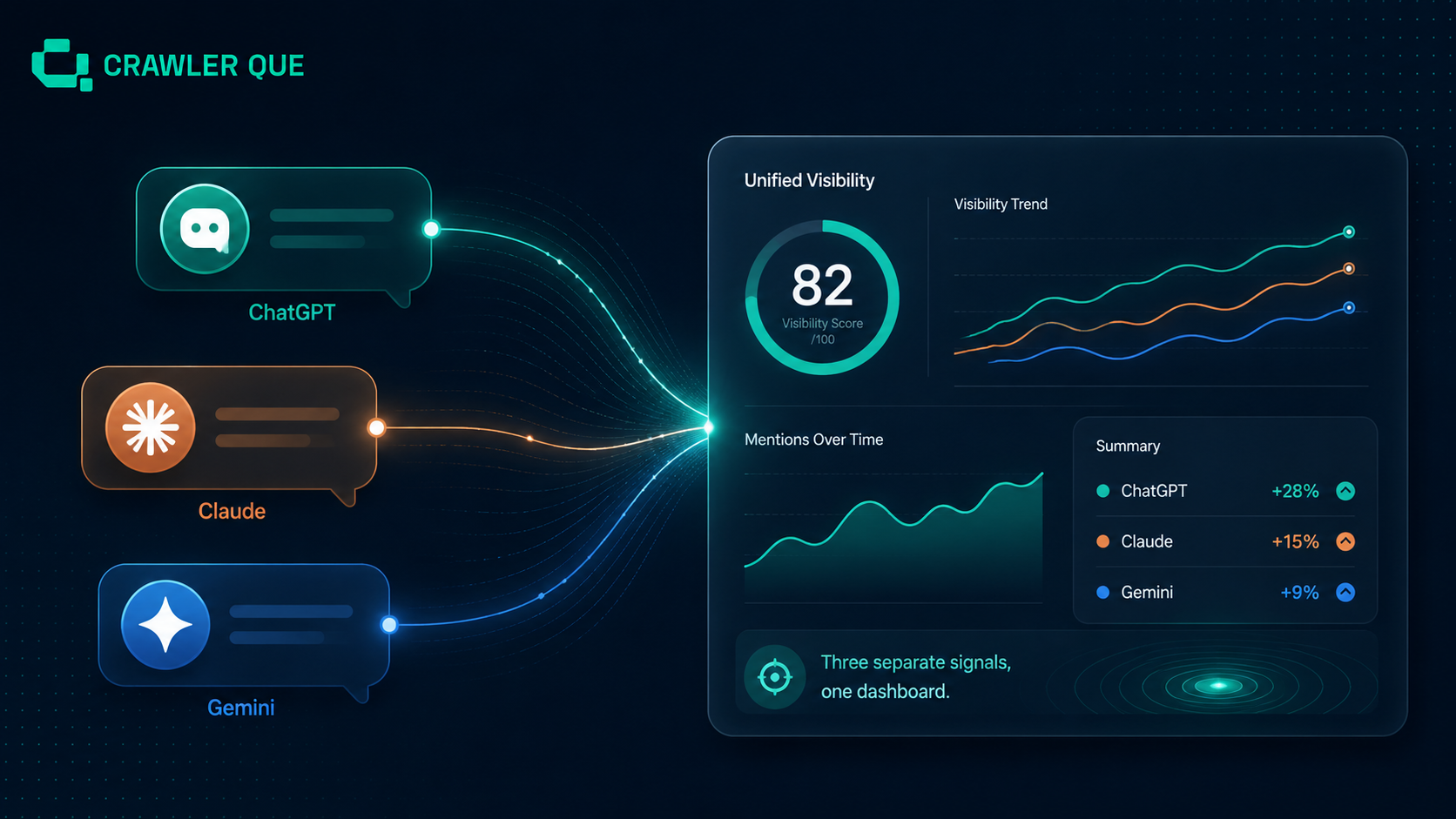
If you've typed some version of "chatgpt perplexity gemini tracker" into Google recently, you already know the problem. You're not looking for three separate tools. You're looking for one answer to one question: is my brand showing up when buyers ask AI for recommendations, and how do I check that without opening six tabs every morning?
That question is bigger than it looks. AI search visibility has quietly become a buying-stage checkpoint, not a novelty metric. According to G2's 2026 AI Search Insight Report, more than half of B2B software buyers now begin their purchasing process inside an AI chatbot instead of a traditional search engine, up from roughly 29% about a year earlier.
If your brand isn't part of the answer at that moment, you're not losing a click. You're losing a shortlist spot before your website ever gets visited.
The 60-Second Verdict
| If you're doing this today | Here's the problem | What fixes it |
| Manually asking ChatGPT "best [category] tools" once in a while | No consistency, no history, no competitor comparison | A repeatable prompt set run on a schedule |
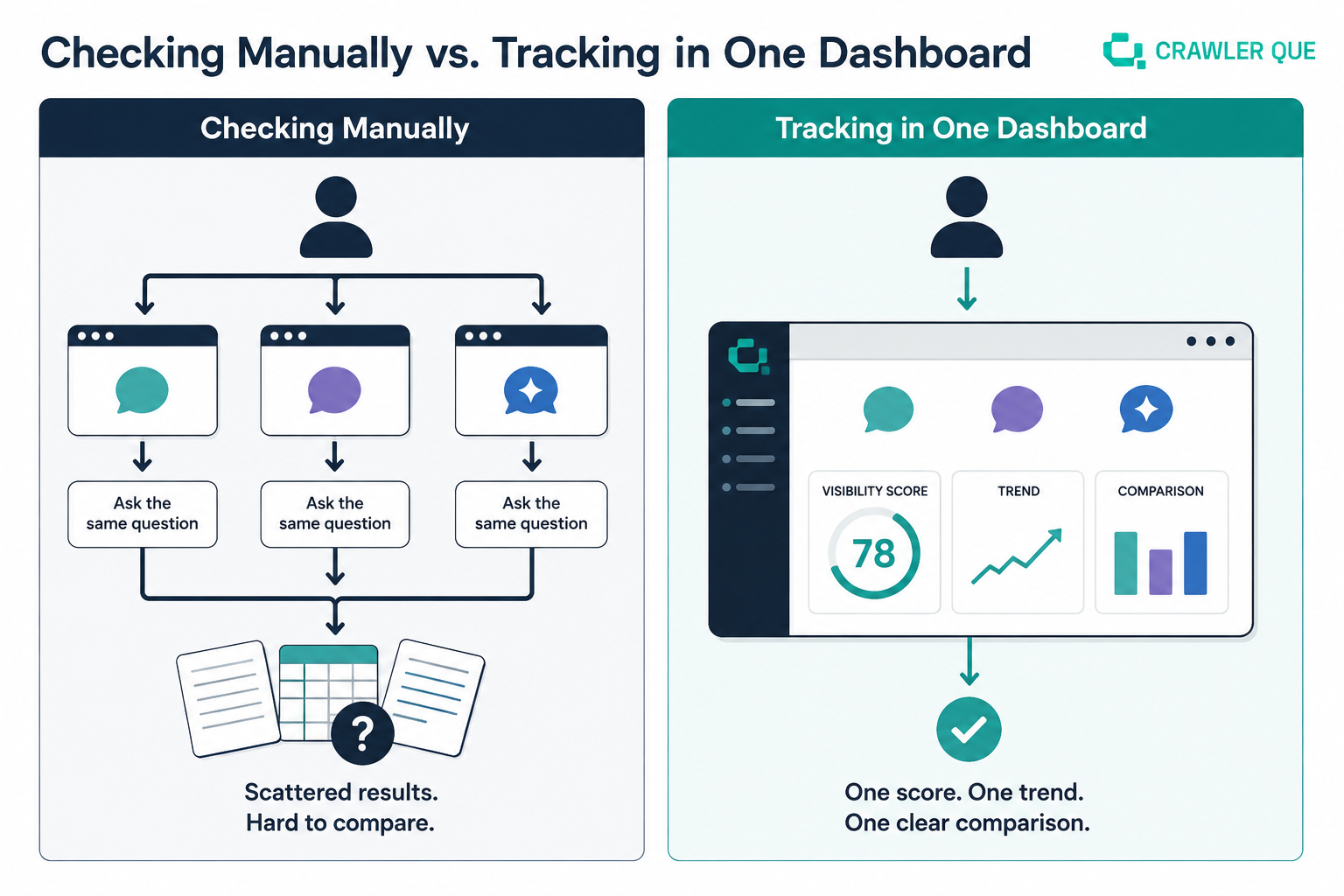
| Checking ChatGPT and Gemini in separate browser tabs | No single score, no trend line, nothing to show a client | One dashboard scoring all models together |
| Only checking ChatGPT | Missing what Claude and Gemini say about you, which can differ sharply | Cross-model tracking, not single-model tracking |
| Guessing why competitors get mentioned and you don't | No visibility into missed prompts or cited pages | A GEO readiness verdict tied to specific fixes |
The rest of this guide walks through what cross-platform tracking actually involves, what a manual version of it looks like, and what changes when you run it from one dashboard instead of three browser tabs.
What "Tracking Brand Visibility Across AI Platforms" Actually Means
Tracking brand visibility across AI platforms means running the same set of buyer-intent questions against multiple AI assistants on a schedule, then recording whether your brand gets named, how it's described, and who gets named instead. It is the AI-era equivalent of rank tracking, except there's no fixed position ten blue links to scroll through. There's just an answer, and your brand is either in it or it isn't.
Three things separate a real tracking practice from an occasional spot-check:
A fixed prompt set. The same 10 to 25 buyer-intent questions, asked the same way, every time. Random one-off prompts produce random one-off results.
A cadence. Weekly or biweekly, not "whenever I remember." AI answers shift as models update and as competitors publish new content, so a single snapshot tells you almost nothing about direction.
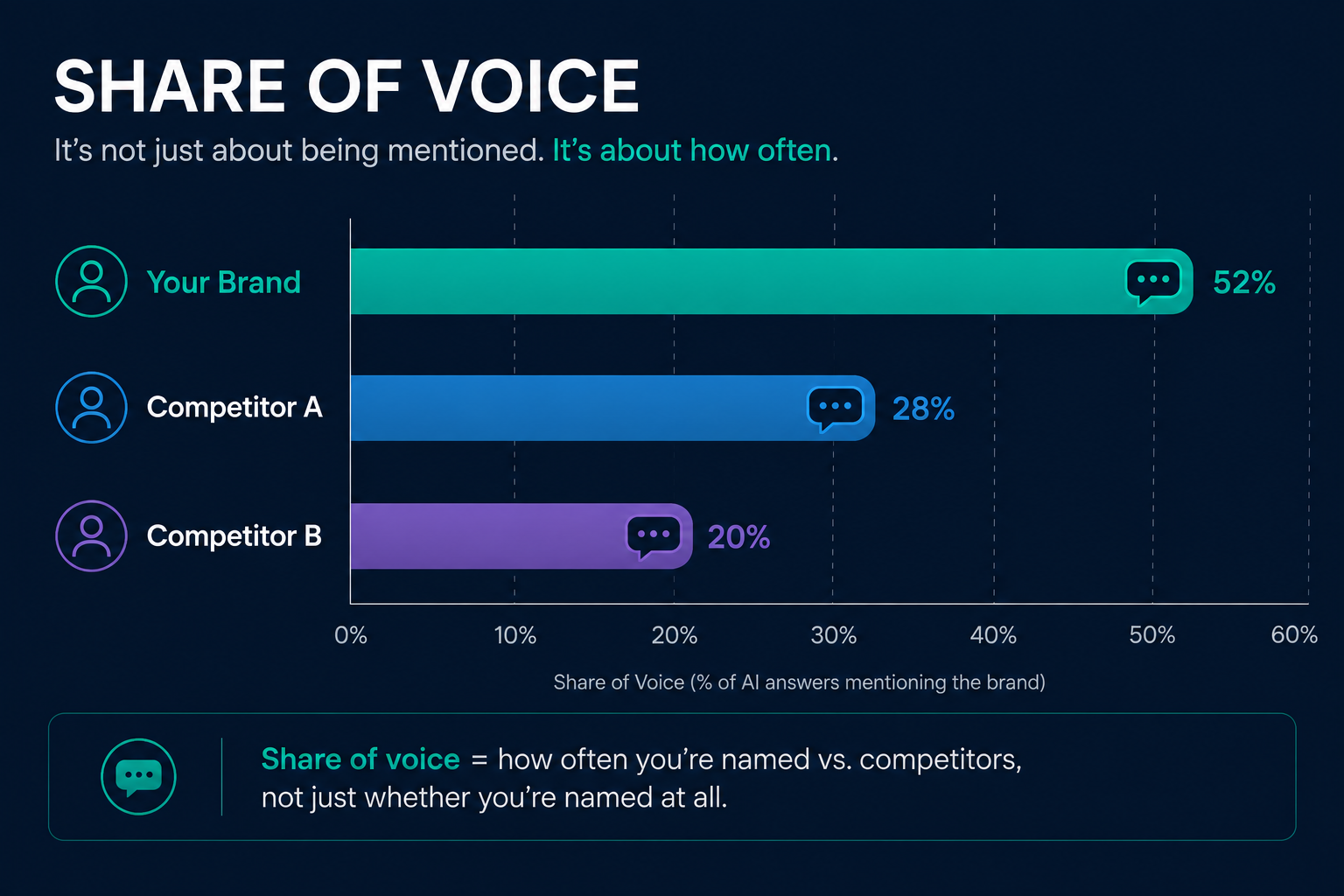
A comparison layer. Your visibility number means little on its own. What matters is your share of voice: how often you appear relative to the two or three brands buyers are actually comparing you against.
If you want the manual, step-by-step version of this before automating anything, this walkthrough covers exactly how to run that check by hand, one platform at a time.
Why Checking One Platform Isn't Enough Anymore
The instinct to just check ChatGPT is understandable. It's the platform most people mean when they say "AI search." But it's also the platform most likely to give you an incomplete picture, because each model retrieves and weighs sources differently. A brand can be described one way in ChatGPT, more cautiously in Claude, and not mentioned at all in Gemini, for the exact same query.
This is where "one dashboard" earns its keep. Instead of three separate mental models of your visibility, a cross-platform view forces the comparison to happen automatically, model by model, so you're not left guessing whether a gap is a fluke or a pattern.
The sourcing behind AI answers is shifting too. A recent Forbes Business Council piece points out that many brands still treat AI visibility like traditional SEO, investing in more landing pages and press releases while buyers increasingly get their answers from forums, reviews, and community threads instead.
A cross-platform check surfaces that gap directly, showing you which sources each model is actually pulling from when it does or doesn't mention you.
Point Tools vs. an All-in-One Dashboard
A small category of dedicated AI visibility trackers has emerged specifically to solve the multi-platform problem: Otterly.AI, Peec AI, Akii, and enterprise-focused players like Profound. Most of them do one job well: running prompts across models and reporting mentions.
| Tool type | Typical entry price | Models tracked | Client-ready reporting | Bundled with a full site audit |
| Dedicated point tool (e.g., Otterly.AI, Akii) | ~$29–$49/mo | 3–4 models | Rarely, usually a paid add-on | No, single-purpose product |
| Enterprise AI visibility platform (e.g., Profound) | Custom/high | 4+ models, daily data | Yes, but enterprise-tier pricing | No |
| Multi-platform tracker built into a site audit tool | $30–$99/mo | ChatGPT, Claude, Gemini | Included on paid plans | Yes, one report covers both |
The trade-off is straightforward. A dedicated point tool gives you a sharper, narrower focus on AI mentions alone. A tracker bundled into a broader audit tool gives up some of that narrow focus in exchange for tying your AI visibility number to the technical and content issues that are actually causing it, in the same report.
If you want to see how Crawler Que's own version of this compares tool-for-tool against the bigger research suites, the Crawler Que vs SEMrush vs Ahrefs breakdown covers that in more depth.
How Crawler Que Tracks ChatGPT, Claude & Gemini in One Dashboard
Crawler Que's AI Search Visibility module runs realistic category and buyer-intent prompts against ChatGPT, Claude, and Gemini, then reports back on four things in a single view: brand recognition by model, an AI Visibility Score out of 100, share of voice against named competitors, and a GEO readiness verdict that points to specific fixes rather than just a number.
A sample run looks roughly like this:
| Model | Visibility rating | What it means |
| ChatGPT | 82% (Strong) | Brand is named consistently across most buyer-intent prompts |
| Claude | 74% (Good) | Brand appears often, with room to close the gap to "Strong" |
| Gemini | 68% (Good) | Lowest of the three, worth checking which prompts are missing you |
Alongside the model-by-model score, the same report surfaces brand mentions, competitor mentions, cited pages, and missed prompts as four separate counts, so a drop in one model's score has a specific, traceable cause instead of just a lower number to worry about.
If you'd rather start with a single-platform check before running the full cross-platform version, the free ChatGPT visibility checker is the narrower entry point, and the AI Brand Checker guide walks through the multi-model version in more detail.
See what a full cross-platform report looks like →
Turning a Cross-Platform Score Into Something You Can Act On
A visibility score by itself is a diagnostic, not a fix. The more useful output is what caused the gap. Two patterns show up constantly once brands start monitoring across models instead of one:
Entity clarity gaps. A brand that's vague about who it is, with no clear About page, no consistent name across the web, and thin schema, tends to score unevenly across models, because each one is working from a slightly different confidence level about what your business actually is.
Missed prompts, not missing content. Often the content that would answer a buyer-intent prompt already exists on the site. It's just not structured in a way that gets pulled into an answer. This is closer to a formatting problem than a content-gap problem, and it's exactly what a "missed prompts" count is meant to surface.
If you want the deeper mechanics of why a brand can rank well in Google and still be invisible in AI answers, this explainer covers the competitor side of that gap directly.
Frequently Asked Questions
Is there a tool that tracks brand visibility across multiple AI platforms at once?
How do I monitor my brand in ChatGPT and Gemini without checking each one separately?
What's the difference between AI visibility tracking and traditional SEO rank tracking?
How often should I check my brand's AI visibility?
Does a higher AI Visibility Score mean I'll get more traffic from AI answers?
The Bottom Line
Checking one AI platform occasionally used to be enough because AI search barely factored into buyer research. That's no longer true, and the brands treating ChatGPT, Claude, and Gemini as three separate side projects are the ones most likely to have a visibility gap they can't explain, because they're only ever seeing a third of the picture at a time.
Ready to see where you actually stand across all three?
Run a free AI visibility check across ChatGPT, Claude & Gemini →
Want to audit your website?
Run a Crawler Que audit to check SEO, Core Web Vitals, traffic signals, competitors, backlinks, recommendations, and AI search visibility.
Run website audit