
Workflow
The 2026 AI Crawlability Audit: Making Sure ChatGPT and Google Can Actually Read Your Site
Check if AI bots can access, render, and extract your content. Free AI crawlability audit covering robots.txt, rendering, schema, and real AI visibility.
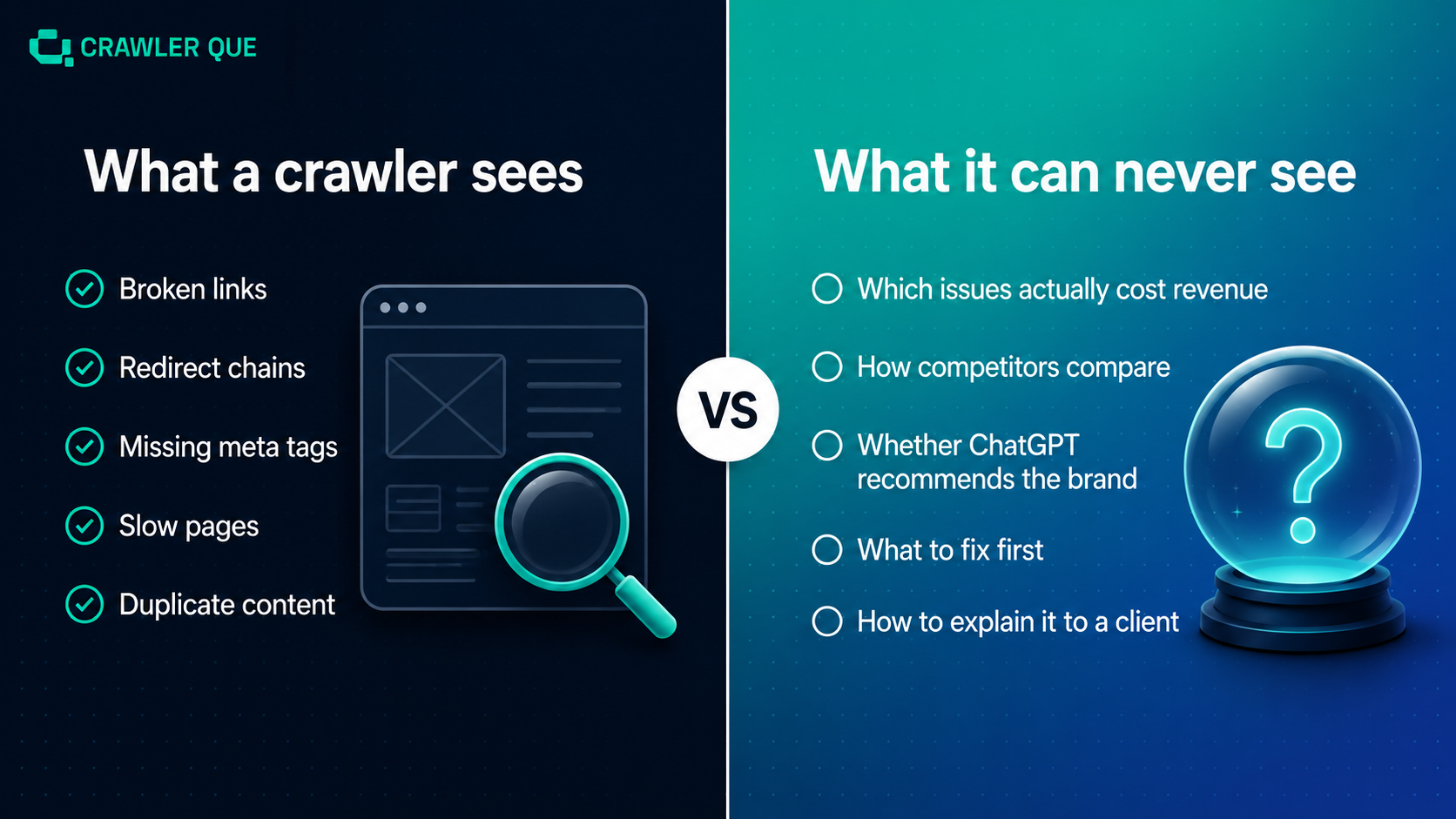
An AI crawlability audit checks whether AI systems, ChatGPT, Perplexity, Gemini, and Google's AI Overviews, can actually access, render, and extract your content. It is not the same as a traditional SEO audit. A page can rank on Google and still be invisible to an AI answer if the wrong bot is blocked, the content only loads after JavaScript runs, or the page has no structured data to confirm what it is about.
Here is what makes this urgent. Google's AI Overviews now appear on roughly 31% of search results pages. ChatGPT processes around 2 billion queries a day. Every one of those surfaces reads your site differently than a human visitor does, and most sites have never checked what that reading actually looks like. We broke down the bigger picture in what an AI website audit tool actually covers; this post goes deep on the crawlability layer specifically.
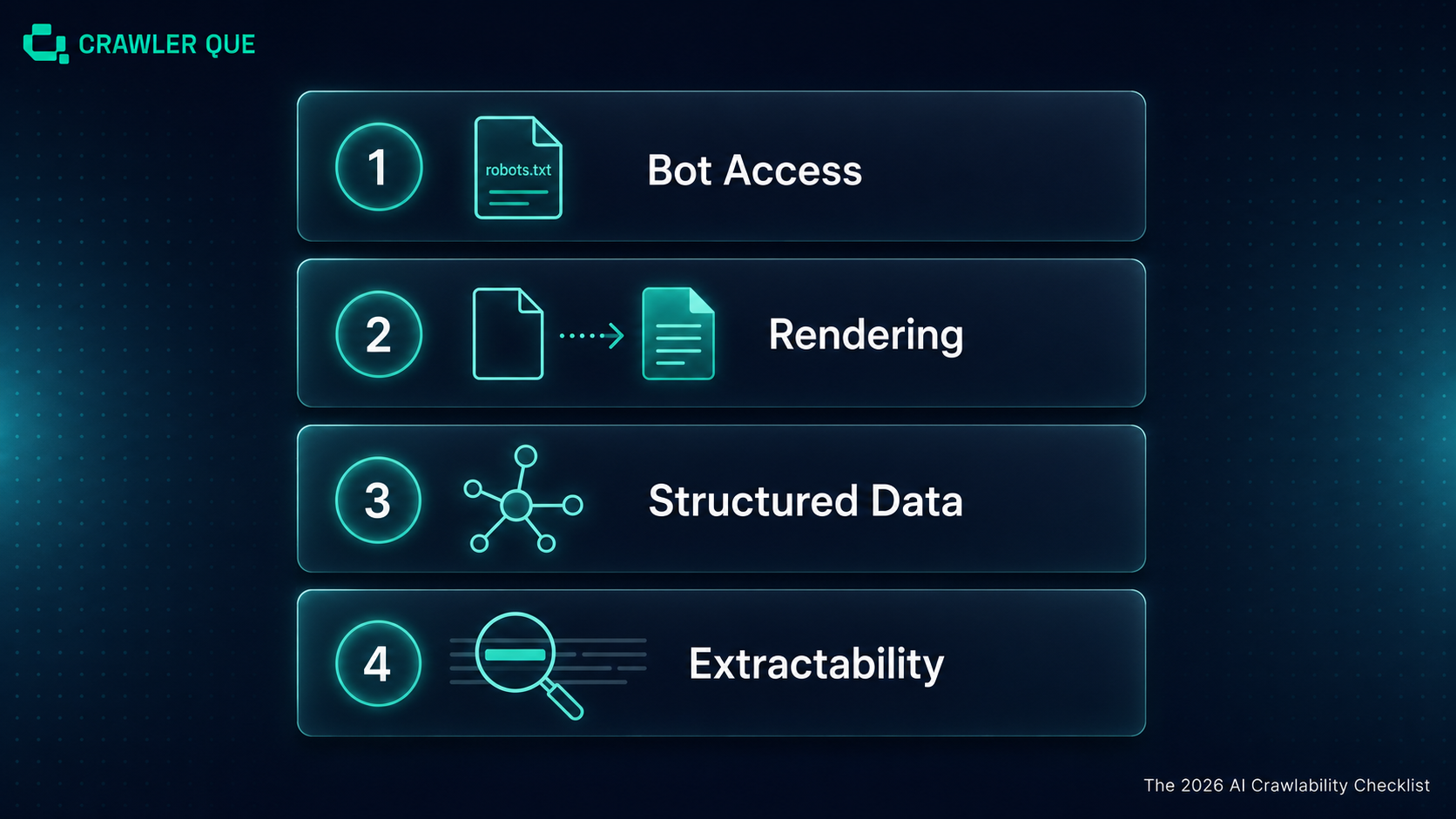
Quick answer: An AI crawlability audit checks four things: which AI bots can reach your site, whether your content renders without JavaScript, whether structured data confirms your content's meaning, and whether your key facts are extractable in plain text. Run a free AI crawlability audit →
Can ChatGPT Crawl My Website?
Only if you let the right bot in, and most robots.txt files get this wrong by accident.
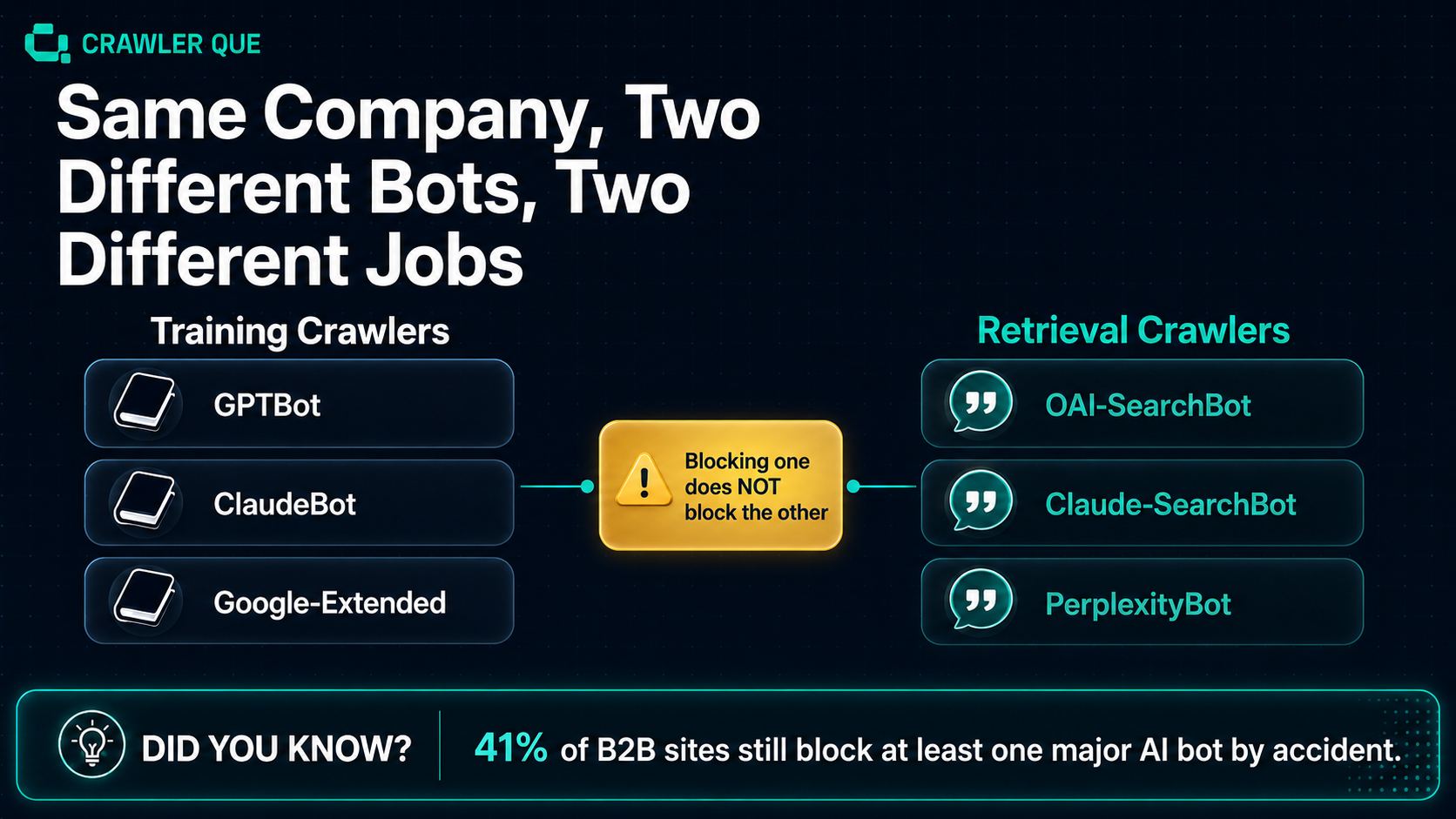
There are two categories of AI bots, and confusing them is the single most common mistake:
Training crawlers collect content to train future models. GPTBot (OpenAI), ClaudeBot (Anthropic), and Google-Extended (Google) fall here.
Retrieval crawlers fetch content in real time to answer a live user question and cite it. OAI-SearchBot, ChatGPT-User, Claude-SearchBot, and PerplexityBot fall here.
Blocking GPTBot does not stop your brand from appearing in ChatGPT Search. Blocking OAI-SearchBot does. OpenAI's own documentation on GPTBot confirms the two serve entirely separate purposes and must be addressed with separate robots.txt rules, a distinction Search Engine Journal covered in detail when GPTBot first launched and one that still trips up most sites years later.
A 2026 audit found that 41% of B2B sites still block at least one major AI bot, usually leftover from a 2023-era "block everything" panic, and each blocked bot costs an estimated 18 to 34% of potential citations on that engine.
| Bot | Company | Type | Recommended default |
| GPTBot | OpenAI | Training | Allow, or block if avoiding training data use |
| OAI-SearchBot | OpenAI | Retrieval | Allow |
| ClaudeBot | Anthropic | Training | Allow, or block if avoiding training data use |
| Claude-SearchBot | Anthropic | Retrieval | Allow |
| Google-Extended | Training (Gemini) | Allow, or block without affecting Google Search ranking | |
| PerplexityBot | Perplexity | Retrieval | Allow (note: independently verified evasive crawling exists) |
One honest caveat: robots.txt is a request, not a lock. It is a voluntary standard that well-behaved bots honor. Cloudflare has documented Perplexity running undeclared crawlers that rotate user agents and IPs specifically to get around site rules.
For most brands, allowing the named bots above is still the right call. If a bot is misbehaving beyond what robots.txt can stop, that is a server or firewall-level problem, not a content one.
Does Your Content Actually Render for AI Crawlers?
This is the failure mode nobody notices until traffic quietly disappears.
Many AI crawlers fetch raw HTML and do not execute JavaScript the way a browser does. If your key content, pricing, product details, and article text only appears after a script runs, an AI crawler may see an empty shell. Your page can look perfect in a browser and be functionally blank to the bot reading it.
It is the AI-era version of a problem our technical SEO checklist already flags for traditional crawlers, just with a less forgiving audience.
The fix is the same one technical SEO has recommended for years, just with higher stakes now: server-side rendering or static generation for anything you need indexed, and a manual check of what a non-JavaScript fetch of the page actually returns.
Does Structured Data Actually Matter for AI Overviews?
Google's own developer documentation on AI features states plainly that there are no additional requirements to appear in AI Overviews or AI Mode, and that the standard SEO best practices that apply to regular Search results apply here too. That single line gets misquoted constantly to mean schema does not matter. It does not mean that.
What the data shows instead: pages with well-implemented schema are roughly 2 to 4 times more likely to appear in AI-generated answers, because structured data resolves ambiguity that a language model would otherwise have to guess at. Schema is not a requirement. It is a clarity advantage, and in a competitive answer, clarity wins the citation. This is the same entity-clarity principle behind Generative Engine Optimization as a whole; crawlability gets you read, GEO gets you cited.
The schema types doing the most work in 2026:
Organization and Person, establishing who is speaking and whether they are credible on the topic
Article, confirming publish date, author, and content type
Product, for accurate pricing and availability in shopping-related answers
FAQPage, which no longer earns a rich result but still feeds AI systems clean, unambiguous question and answer pairs
The Four-Part AI Crawlability Checklist
Run through these before assuming your content is AI-visible:
Bot access. Audit robots.txt for every major training and retrieval bot individually. No wildcard guesswork.
Rendering. Fetch your key pages the way a bot would, without JavaScript, and confirm the content is actually there.
Structured data. Validate Organization, Article, and FAQPage schema on your most important pages.
Extractability. Read your content as if you were an AI looking for one clear answer. Buried claims, vague phrasing, and paragraph-only formatting all make extraction harder.
Crawler Que's AI Search Visibility module runs a version of this checklist automatically, then goes one step further: it tests real buyer prompts against ChatGPT, Perplexity, and Gemini to show whether your brand actually gets recommended, not just whether it is technically reachable.
If you want the step-by-step manual version first, here is how to check that yourself before automating it.
Find out if AI can actually read your site. Free audit, no signup, results in under 2 minutes. See a full sample report →
FAQ
How do I dominate AI search results in 2026?
There is no shortcut around the fundamentals: confirm AI bots can reach your content, make sure it renders without JavaScript, add clear structured data, and write content that states its answer plainly instead of burying it in marketing language. Dominating AI search is mostly removing the technical and clarity barriers everyone else still has.
What is an AI search visibility audit?
It measures whether AI models mention, recommend, and cite your brand when real buyers ask relevant questions, then scores that visibility against your competitors. It is different from crawlability: crawlability asks "can AI read this," visibility asks "does AI recommend this." You need both, and we go deeper on the distinction in our guide to AI search visibility.
Does Google approve AI content?
Google does not require content to be human-written, but its guidance is explicit that content produced primarily to manipulate rankings, AI-generated or not, violates its spam policies on scaled content abuse. The standard is quality and originality, not authorship method.
How do I rank in Google AI Overviews in 2026?
The same signals that earn strong organic rankings largely determine AI Overview inclusion: helpful, people-first content, solid E-E-A-T signals, and clean technical health. Structured data adds a meaningful boost on top of that foundation; it is not a substitute for it.
How do I win AI search?
Be the source that answers the question most clearly and can be verified fastest. AI systems favor content with unambiguous facts, credible authorship, and structured data over content that is vague but well-written. Clarity beats cleverness in this format
How do I limit AI search results?
To keep content out of AI training, block the training-specific bots, GPTBot, ClaudeBot, Google-Extended, in robots.txt. To keep content out of live AI answers entirely, also block the retrieval bots, OAI-SearchBot, Claude-SearchBot, PerplexityBot. Understand the tradeoff first: blocking removes you from citations as well as training, and publishers who blocked broadly in 2025 saw meaningful traffic declines without a matching drop in how often their content was scraped anyway.
See exactly what AI can and can't read on your site
Run a free Crawler Que audit covering bot access, rendering, structured data, and real AI visibility across ChatGPT, Perplexity, and Gemini. No signup, results in under 2 minutes.
Want to audit your website?
Run a Crawler Que audit to check SEO, Core Web Vitals, traffic signals, competitors, backlinks, recommendations, and AI search visibility.
Run website audit